
Contact Us
TESOL Undergraduate Options

We offer 3 undergraduate options — find complete requirements for the Minor and Certificate below:
- TESOL Minor:
24-credit program develops marketable skills beyond the basic credential for teaching English anywhere in the world. - TESOL Certificate:
15-credit program provides a recognized credential for teaching English outside of the United States. - Combined BA/MA in TESOL:
Fulfill up to 12 of 30 MA credits with your undergraduate coursework; combine with any major — learn more about the BA/MA option.
These majors combine well with all 3 TESOL undergraduate options:
- SIS: International Studies
- SOC: Communication, Language, & Culture; Journalism; PR & Strategic Communications
- SOE: Elementary Education; Secondary Education
- SPA: CLEG; Justice & Law; Political Science
- CAS: American Studies; Anthropology; Arab World Studies; Asia, Pacific, & Diaspora Studies; Chinese Studies; French Studies; German Studies; Graphic & Visual Communication Design; Japanese Studies; Language & Area Studies; Psychology; Russian Studies; Sociology; Spanish Studies
TESOL Minor & Certificate Pathways
Students have flexibility in how they complete their minor and certificate requirements, with most students beginning in their sophomore year. Most TESOL courses are only offered once a year, so advance planning is necessary — note that the only summer course is TESL-454.
Required Courses by Semester
| Required Course | For Minor/Cert/Both | Fall | Spring | Practicum Component? |
|---|---|---|---|---|
| TESL 200 | Minor | Yes | ||
| TESL 220 | Minor | Yes | ||
| TESL 400 | Certificate | Yes | Yes | |
| TESL 401 | Both | Yes | Yes | |
| TESL 402 | Both | Yes | Yes | |
| TESL 420 | Minor | Yes | Yes |
Elective Courses by Semester
| Course | Fall | Spring | Practicum Component? |
|---|---|---|---|
| TESL 400 | Yes | Yes | |
| TESL 423 | Yes | ||
| TESL 424 | Yes | Yes | |
| TESL 426 | Yes | ||
| TESL 427 | Yes | ||
| TESL 445 | Yes | Yes | |
| TESL 454 | *Only in Summer | Yes | |
Alumna Spotlights: Romy Hermans & Fiona Goe
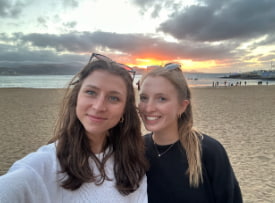
Romy Hermans (left), BA in International Relations and French, and Fiona Goe (right), BA in Communication, Language, and Culture, share their teaching journeys — Romy in southern France near Toulouse, and Fiona in Gran Canaria, Spain.
See more alum and student features.
Romy's Story
This year, I have been teaching in Montauban, a town about 45 minutes outside of Toulouse, France. My students are in primary school, ranging from 5 to 11 years old. Working with this age group was entirely new to me, and as a result, I have expanded my teaching portfolio in numerous ways. To keep students engaged, I use dynamic activities that encourage interaction with English beyond the traditional French classroom environment. I have also learned that activity pacing varies significantly by age group. My youngest class, “CP,” requires simple activities that change every five minutes, while my older students prefer more in-depth cultural lessons with a new activity every 20 minutes. Active assessment is crucial for effectively teaching this learner population. The AU TESOL program has been invaluable in helping me feel confident and successful in TAPIF. I frequently refer back to our unit presentations, where we received feedback from the "brain trust," to determine what strategies would be most effective. Many of these activities, adapted based on feedback from our TESOL critique sessions, have become staples in my classroom. Additionally, I draw on our TESOL coursework when incorporating American culture into my lessons.
One of the biggest challenges I have faced is navigating the different co-teaching dynamics in each class. Every teacher has a unique level of English proficiency, different expectations, and varying degrees of involvement in the lessons. This requires a great deal of flexibility and resourcefulness, as well as the ability to step in and teach independently when needed. I see this as an opportunity to design my very own lessons surrounding American culture, giving me creative freedom over both the material and teaching style.
For AU students planning to teach English abroad, my biggest piece of advice is to embrace making mistakes. When I taught for this first time, I made plenty of mistakes but my students rarely noticed when something didn’t go as planned. There is always a chance to learn, adapt, and try again.
Fiona's Story
I have been teaching at an elementary school in Gran Canaria, Spain for the past year.
My school has around 150 students between 5-12 years old. I have taught gym, emocrea (emotions and creativity), art, and English classes. There is a wide variety of English levels at my school, depending on if the kids attend an English academy. At first, it was a challenge to design lesson plans that would be intellectually stimulating for the whole class. Instead of making the content drastically too simple for those with high English levels, I have modified the way that I deliver the content. This means ridiculously acting out the words and phrases so that each of the students understand what is happening. If I am talking about trees, I put my arms above my head to symbolize a tree. If I am teaching about a rainbow, I’ll do an exaggerated arc above my head. This has not only kept students engaged, but helped those at lower levels understand the terms that their classmates may already be familiar with.
AU TESOL has taught me how to make a lesson plan effectively using the backward design model. I think of a goal that I want the students to accomplish like how to communicate the reason why they feel happy, sad, angry, etc. In order to do that, they need example sentences and certain vocabulary words. An example sentence could be: “I am happy because I am doing _____.” They can fill in the blank with the words that they already know. In order to gain confidence, they can walk around the class and repeat the sentence to their classmates.
Tutoring with the Washington English Center also prepared me for the tutoring that I am doing in Gran Canaria. I have 5 students between 2nd and 7th grade that I meet with twice a week. Each of the kids are at different skill levels and have varying needs. When I was a volunteer at WEC, I created lesson plans for students that wanted to work on their listening and reading comprehension. I found materials that were interesting to the students and created pre- and post-listening/reading comprehension questions. I have continued to implement these strategies with the students that I have here.
A funny story from St. Patrick’s Day this week, my coworkers wanted me to organize activities for the students to do during class. With each class at the school (3 years-6th grade), I did three activities: reading a story, a craft, and an Irish Dance lesson. I wrote a story about a boy that met a Leprechaun, found his pot of gold, and learned that friendship is more important than gold. I required the 4th-6th graders to read the story, while I read/acted the story out for the younger kids. For the craft, the students had to write one thing that they are “lucky for” on a 4-leaf clover, which was then hung up in the hallway.
Lastly, I taught the kids how to Irish Dance. This was a full-circle moment for me because I did competitive Irish Dance for 12 years during my childhood. It was not only a challenge, but also so entertaining to teach little Spanish kids how to do a Jig. Some of them got the hang of it, but for most of them, it was a complete disaster. It was definitely the best teaching experience that I’ve had so far as it was heartwarming to see the kids completely enthralled in the sport and crazily jump around swinging their legs every which way.
A tip for AU students who are interested in teaching English abroad is just do it! Although I took two TESOL classes at AU, I felt like I didn’t know the first thing about teaching when I first arrived in Spain. Since September, I have gained so much confidence in the classroom because even if your lesson plan isn’t exactly a success (it happens to all of us), because the kids are learning just by hearing you speak. You will also grow so much both inside and outside school by truly integrating yourself into a foreign community.
 Course Requirements for the Minor & Certificate