
AU Climate Scientist Helps Decode Most Explosive Volcano on Record
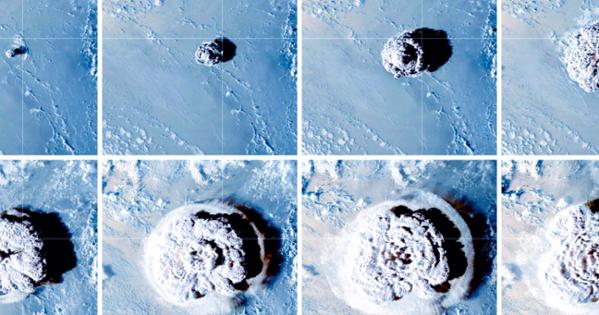
In January 2022, a massive underwater volcano near the Pacific island nation of Tonga erupted with extraordinary force, becoming the most explosive volcanic event of the satellite era, according to a new international assessment coauthored by American University climate scientist Valentina Aquila. The blast from the eruption of Hunga Tonga–Hunga Ha’apai sent tsunamis across oceans and shockwaves around the globe, while satellites tracked it soaring higher into the atmosphere than any eruption ever recorded.
Aquila, chair of American University’s Department of Environmental Science, was one of 159 scientists from 21 countries who contributed to the Hunga Volcanic Eruption Atmospheric Impacts Report, released by the World Climate Research Programme’s Atmospheric Processes and their Role in Climate (APARC) project. Aquila, an expert in using climate models to study volcanic eruptions, teamed up with Rei Ueyama of NASA’s Ames Research Center to put those models to the test after the Hunga eruption. Drawing on simulations from seven cutting-edge climate models, the pair examined how well the models captured the eruption’s atmospheric aftermath. Their analysis showed that the models performed well, successfully tracking the movement and evolution of the massive amounts of water vapor and particles released by the eruption.
The report was first publicly unveiled at a press conference during the fall meeting of the American Geophysical Union in New Orleans on December 18, 2025.
Insights Into Atmospheric Responses
The assessment shows that the Hunga eruption injected an unprecedented amount of water vapor into the upper atmosphere, altering temperatures high above Earth’s surface and giving scientists a rare opportunity to observe how the atmosphere responds to an extreme natural event.
Unlike previous eruptions, which mainly sent sulfate particles into the stratosphere, Hunga also blasted an enormous surge of water vapor into a region that is usually extremely dry. Scientists expect some of this water will linger in the stratosphere until 2030. In principle, such an unusual injection could have thinned the ozone layer or warmed surface temperatures, since water vapor is a greenhouse gas—but the new international assessment finds that it did not.
“It turns out that the size of the particles was in the optimal range to reflect solar radiation and cancel the warming from the water vapor,” Aquila explains. “This means that, overall, the changes in the Earth’s surface temperatures caused by Hunga are not distinguishable from the normal year-to-year variations, and that the record temperatures recorded in 2023 and 2024 were not the result of the eruption.”
Why the Findings Matter
Aquila says the assessment matters because rare events like Hunga help scientists test and strengthen their understanding of how the climate system works—especially the tools used to make future projections.
“Climate models are built and tested using events we’ve already observed,” Aquila said. “Until now, most volcanic eruptions we could study mainly released sulfate particles, and our models were designed around that.”
“Hunga was different,” she added. “It gave us a chance to test those models under conditions we hadn’t seen before, and to confirm that they can still provide reliable information even when nature pushes the system in a new direction.”
The assessment’s findings will feed into the 2026 UNEP/WMO Scientific Assessment of Ozone Depletion, a major international review of the state of Earth’s ozone layer.