Department of History Blog
Explore the history community at AU and learn about the achievements and activities of our students, faculty, and alumni.

Offering doctoral, master's, public history, and bachelor's programs.
Battelle Tompkins , Room 137 on a map
History 4400 Massachusetts Avenue NW Washington, DC 20016-8038 United StatesHistory classes hone our students' research, writing, and analytical skills. Our home in Washington, DC, offers students unparalleled resources for research, internships, and jobs. The nation's capital is our classroom.
Our outstanding faculty are not only exemplary teachers and scholars, but they are also actively involved with archives, museums, government institutions, and non-profits in DC, across the United States, and around the world. Whether you are interested in working in government, private industry, non-profits, or academia, AU's Department of History offers a stepping stone to a promising career.
The History Department offers a BA, a minor, a combined BA/MA, an MA in History, an MA in History with Public History Concentration, and a PhD.
American University's Combined BA/MA Degree program allows students to complete both their BA and MA in History in as little as 5 years. Students in the BA/MA program save upwards of $22,000 in tuition costs by sharing credits between the two degrees.
Students may pursue either the General MA program or the Public History Concentration. Inquire at history@american.edu to learn more about our BA/MA program.
See Eagle Service course catalog for all History courses offered this semester.
3 credits, Laura Beers, Tuesdays & Fridays, 2:30 PM - 3:45 PM
This course examines phenomena that have defined Britain's place in the world, such as the ascension of parliament, the industrial revolution, and the growth of empire, to understand what is unique about Britain and which elements of the British historical experience are more broadly shared. Usually Offered: spring.
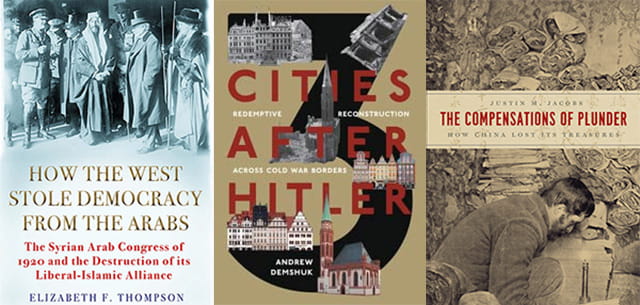
3 credits, Justin Jacobs, Tuesdays & Fridays, 9:45 AM - 11:00 AM
An introduction to the history of premodern continental East Asia, from oracle bones to the impact of the West. This course examines the ideological foundations of the imperial system, major schools of philosophical thought, the role of nomad incursions, and language and script, along with major issues concerning gender, religion, and education.
3 credits, Mary Habeck, Wednesdays, 2:30 PM - 5:20 PM
The course of European history was changed forever when the Vikings began to take an interest in their neighbors. What began as a series of small but devastating raids in the late eighth century soon mushroomed into a mass movement of Scandinavians to Ireland, Britain, France, and beyond, forever altering the landscapes of these kingdoms. To their victims they were heathen pirates who killed without regard for age, gender, or status. But the Vikings also impacted Europe in more positive ways, opening up long-distance trade routes and encouraging urban development, among other things. This course takes a broad view of the Viking world by considering the evidence for the Vikings themselves as well as their impact abroad. Students use material evidence (i.e., archaeology) and primary sources to better understand Viking society and religion, technology, ways of warfare and influence across time and space.
3 credits, Daniel Richter, Mondays & Thursdays, 11:20 a.m. - 12:35 p.m.
Soccer, more widely known as football, is the most popular sport in the modern world and arguably more important than any form of organized religion for many fans of club and national teams. In this course, football and soccer are used interchangeably while accounting that only in the United States is the sport primarily known as soccer. The course explores how and why global football has influenced and been influenced by politics, economic, and cultural relationships. It focuses on the transnational history of football, with an emphasis on players and managers such as Pele and Diego Maradona as global figures who have impacted local cultures in numerous locations during their careers. The course covers the intertwined histories of the sport in Europe, Latin America, the United States, Africa, and Asia.
3 credits, Katharina Vester, Thursdays, 5:30 PM - 8:00 PM
This course explores a diverse range of cultural phenomena in the nineteenth century United States, reflecting on how clothes, interior design, child rearing philosophies, nutritional advice, travel literature, and pets can shape society and politics.
3 credits, Andrew Demshuk, Tuesdays, 5:30 p.m. - 8:00 p.m.
While humans have always sought to change the planet as suits their creative pleasure and often short-sighted greed, the twentieth century (especially its latter half) witnessed our species' initiation of drastic changes to Earth's water, atmosphere, topography, and natural organisms that could imperil the survival of humanity itself. This course examines how scholars have understood human-made changes to the Earth's ecology over time, and examines the legacies of communism and capitalism, nationalism, imperialism, total war, forced migration, new energy regimes, and other human-made practices upon the planetary environment that humans still inhabit. Through exploration of quandaries and questions in environmental history, students combine global analysis with local case examples and are introduced to historical methodologies through critical analysis of primary and secondary sources. Students assess weekly course readings through critical review papers, a review essay, analysis of a particular scholar's publishing trajectory, a short historiographic final essay, and oral presentations. Note: No prior knowledge of environmental history is expected.
Explore the history community at AU and learn about the achievements and activities of our students, faculty, and alumni.
History PhD Alum Lauren Duval was awarded the 2026 Distinguished First Book Award for a First Book by the Society for Military History for her book The Home Front: Revolutionary Households, Military Occupation, and the Making of American Independence.
PhD Candidate Reza Akbari published "'Unconditional Surrender' is Always an Illusion: An American myth reemerges for the Iran War" with Foreign Policy.
Professor Allan J. Lichtman's Conservative at the Core has been nominated as a finalist for the Foreword INDIES Book of the Year Awards in the History category.
Professor Pamela Nadell’s Antisemitism, an American Tradition won the 2026 National Jewish Book Award in American Jewish Studies.
Professor Theresa Runstedtler appears in the docuseries based on her book, Soul Power: The Legend of the American Basketball Association. The docuseries premiers on Amazon Prime.
Professor M.J. Rymsza-Pawlowska published "'Play the Long Game': Public Historians' Approach to the Semiquincentennial and Beyond" in The Public Historian.
History PhD alum Nathan Sowry published Indian Boarding Schools, Native Anthropologists, and the Race to Preserve Indigenous Cultures (University of Nebraska Press, 2025).
Pam Nadell published "Smokescreen: Antisemitism on campus is real—and the Trump administration is exploiting it" in Liberal Education.
History PhD alumna Lauren DuVal, Assistant Professor at the University of Oklahoma, published her first book, The Home Front: Revolutionary Households, Military Occupation, and the Making of American Independence (UNC Press, 2025).
Prof. Kate Haulman published The Mother of Washington in Nineteenth-Century America with Oxford University Press (September 2025).
The Department of History hosted our first Shelf Life Book Sale on October 16. Check out this article from The Eagle recapping the event.
PhD Candidate Reza Akbari participated in a roundtable discussion hosted by Security in Context on the strategic logic of Iran's foreign policy during the "12-Day War."
Alum Thomas Hauser published Seizing the Electronic High Ground: Transforming Aerial Intelligence for the United States Army.
The Department of History recognized PhD Candidate Henry Dickemyer as History Teaching Assistant of the Year for academic year 2024-2025. Congratulations, Henry!
Prof. Laura Beers has been awarded a 2025 Guggenheim Fellowship as part of the 100th class of fellows for the Guggenheim Foundation. Her book, Orwell's Ghosts (W. W. Norton & Coo., 2024), has also been awarded a Los Angeles Times Book Prize in the biography category.
The Department of History and the Jewish Studies Program held the annual Brandenburg Lecture & Annual Awards Ceremony, April 9, 2025, featuring Julie Keresztes and her recently published book, Photography and the Making of the Nazi Racial Community. Watch the lecture.
Check out our 2023-24 newsletter! See what we got up to last academic year, including faculty and student achievements, events, and more. Read the newsletter.
Doctoral student Paul Kutner published an article with Medium on Bishop Mariann Edgar Budde's speech on January 21.
Theresa Runstedtler spoke with Time about race, sexuality, and gender- themed conversations surrounding Caitlin Clark’s inaugural WNBA season.
Allan Lichtman spoke with NPR about President-elect Donald Trump’s decision to invite Chinese leader Xi Jinping to the inauguration.
Peter Kuznick co-authored an article for The Nation about Nihon Hidankyo’s receipt of the Nobel Peace Prize.
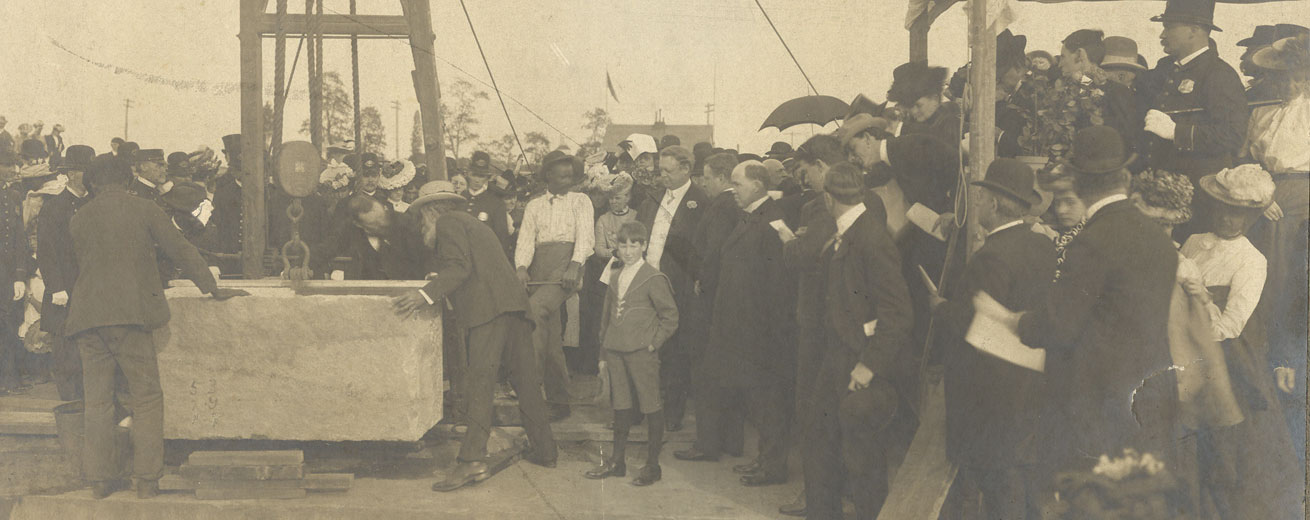
Top image credit: Teddy Roosevelt (right of man in white vest) watches the laying of the cornerstone for AU's McKinley Building, 1902. AU Archives.