
A Dream, Fractured
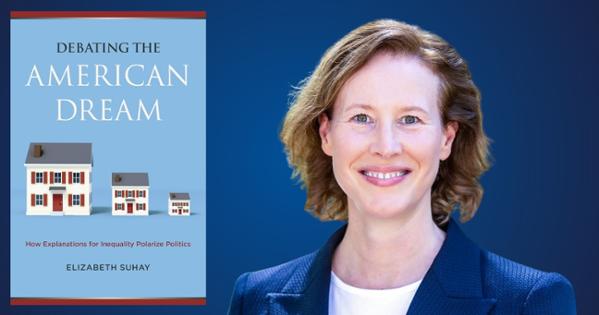
The very notion of “The American Dream" – the belief that hard work leads to success and a comfortable life – has become a battleground in American politics, polarizing the public along party lines. While some blame individuals for their economic struggles, others point to systemic flaws within the economy itself. The partisan nature of this schism forms the core of SPA Professor Elizabeth Suhay’s new book, Debating the American Dream: How Explanations for Inequality Polarize Politics (Russell Sage Foundation Press).
Suhay’s argument, based on decades worth of data on public opinion and political platforms, is that political leaders actively construct economic ideologies that justify partisan agendas, influence public perception, and unify their respective coalitions while driving a wedge through the broader American public.
The Genesis of an Ideal
The phrase "The American Dream," coined by author James Truslow Adams in his 1931 book The Epic of America, initially represented a goal, more aspiration than reality.
“The American dream is one of our most cherished ideals,” says Suhay. “It means, essentially, that if you work hard, you ought to succeed. You may or may not get rich, but you deserve at least a comfortable middle-class lifestyle.”
This peculiarly American phenomenon held significant power for early settlers, particularly European immigrants. The nation genuinely offered unprecedented upward mobility, allowing newcomers to earn more than they could in their home countries, with their children often surpassing them. This experience cemented the belief, passed down through generations, that the United States was a land where effort translated into prosperity (at least for white European men).
At the heart of this ideal lies the concept of "meritocratic abundance." This principle suggests that the nation's economy should generate ample opportunities for all, distributing them based on merit – hard work and skill – rather than on patronage, inherited wealth, or social identity.
“It's a goal towards which we're striving,” says Suhay. “But frankly, the nation often falls short.”
A Century of Partisan Battle Lines
For much of their history, the Democratic and Republican parties have approached the American Dream from distinct angles, though these differences expand and contract over time.
The Republican Party has traditionally acted as what Suhay terms "American Dream optimists," insisting that opportunity is widely accessible. This stance aligns with the party’s historical representation of big business and affluent individuals.
“Historically, members of the Republican coalition had every incentive to argue that everything's OK,” says Suhay. “What little inequality exists is meritocratic, meaning that affluent individuals essentially deserve their wealth and low-income individuals deserve to have less than others. And if they are hardworking, well, they'll be relatively affluent soon.”
Meanwhile, Democrats, or "American Dream pessimists," have long questioned the reality of this ideal. From their founding in the 1830s, the party positioned itself as a critic of economic inequality, arguing that the nation's wealth was unfairly distributed and that the economy was rigged by elites against ordinary people.
“The Democratic Party, when it was founded, was a party of lower-income white people,” says Suhay, “largely farmers who, perhaps legitimately, felt locked out of the nation's wealth.”
Even so, she notes that the partisan divide wasn't always as this stark: the late 20th and early 21st century marked a dramatic shift. Economic upheavals, most notably the Great Recession of 2007-2009, deepened the chasm between the parties' economic narratives.
"Democratic activists and interest groups were very alarmed by the Great Recession and pushed the party to the left on economic policy," Suhay explains. Soon figures like Bernie Sanders and Elizabeth Warren emerged, making a forceful case that the system was indeed rigged against working people.
In response, the Republican Party doubled down on the meritocratic narrative, dismissing calls for more progressive policies. Despite its increasingly working-class coalition, the party’s longstanding commitment to “small government” and deep-pocketed donors have inhibited its responsiveness to Americans’ economic struggles.
The result is a split grown into a chasm, says Suhay, rivaling the polarization seen on issues like abortion or gay rights. "Economy opportunity/inequality may be the most central debate in American politics," she observes, considering the disagreement inevitable in such a highly polarized era.
Overlooked Inequalities and Their Lessons
Beyond the well-trodden ground of class, race, and gender – what Suhay terms the "inequality trio" – other economic disparities, such as the rural/urban socioeconomic divide, receive surprisingly little attention in U.S. political discourse. She proposes two reasons for this avoidance.
“Democrats like to talk about the injustice of inequality, but they focus on members of their coalition, who do not tend to be rural,” she says. “Rural voters also get ignored to a significant extent by the Republican Party: it doesn’t talk much about equality, [and] its agenda just isn't oriented toward the economic needs of rural Americans.”
This collective political silence, Suhay argues, actively shapes public opinion, leading citizens to associate inequality solely with class, race, and sex and push other disparities aside.
She identifies two crucial lessons for political scientists. Firstly, the national conversation and the words of political leaders dictate which inequalities are debated and how. Secondly, the partisan divisions observed among ordinary citizens are not intrinsic psychological traits, but rather products of partisan socialization.
This latter point offers a silver lining, says Suhay. “This [polarization] is not necessarily permanent. . . if political leaders became interested in depolarizing, the public would happily follow suit."
Charting a Path to Unity
But if a political actor, campaign, or party wanted to close the partisan divide, how could they do so?
While the book is nonpartisan, Suhay does evaluate each party’s economic narratives and maintains that Democratic messaging more closely represents reality. However, she recommends broadening that message by moving away from narratives exclusive to the social identity groups that predominantly vote Democratic. Such an approach, she believes, alienates others and represents a missed opportunity to connect with working people more broadly.
"The irony is that Democratic policies often do help a wide range of groups, including rural Americans, but they don't include it in their messaging," she notes.
Furthermore, Democrats would benefit from embracing greater complexity regarding the causes of and solutions to inequality. While the "The system is rigged!" narrative highlights institutional barriers, Suhay believes it isn’t quite so simple. She cites marriage as an example: while perhaps overemphasized by Republicans, it offers significant protection against poverty. Encouraging marriage, an aspiration for most people, could attract more conservative voters without compromising Democratic values.
For Republicans, the path forward is different but equally vital. While their “You can do it!” ethos satisfies the human desire for optimism and individual capability, and while people largely find work meaningful, this message is increasingly falling flat. "People are growing tired of being told that the U.S. economy is essentially meritocratic,” says Suhay. “It just doesn't ring true today."
“Republicans need to get serious about developing high-quality policy proposals that address extreme economic inequality and wage stagnation by alternative means,” she continues. Such ideas, she believes, are out there: the party simply needs to commit to developing them.
Suhay’s Debating the American Dream offers a framework for understanding the profound political and economic divisions plaguing the United States. Its analysis, accessible to academic, Beltway, and popular audiences alike, does more than diagnose this polarization: it provides a glimmer of hope for a more unified path forward.
Debating the American Dream: How Explanations for Inequality Polarize Politics is available for purchase at Russell Sage (use the code “Holiday25” for 25% off) and Amazon.