
ISA 2026 Conference in Columbus Highlights SIS Faculty and PhD Student Research
The annual conference for the International Studies Association (ISA) provides an opportunity for international affairs scholars to present their research, engage in academic and policy discussions about key topics, and connect with colleagues from across the United States and the world. This year, 21 SIS faculty and 6 PhD students attended the ISA 2026 conference in Columbus to showcase their research and participate in roundtables and panel discussions. SIS also hosted a reception for faculty, PhD students, alumni, and friends to catch up and mingle. Here are a few research highlights from the conference:
Polina Beliakova, “Putin and His Generals on the Way to Ukraine: The Structural Theory of Civil-Military Relations Under Civilian Control”
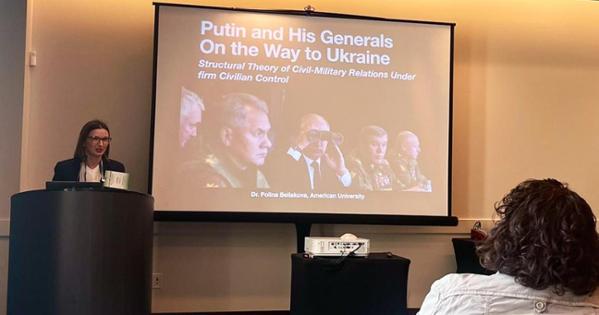
SIS Professor Polina Beliakova chaired a panel on civilian control of the military and security forces and presented her paper “Putin and His Generals on the Way to Ukraine: The Structural Theory of Civil-Military Relations Under Civilian Control.” In the paper, Beliakova introduces a new structural theory of civil-military relations to help explain why scholars failed to predict the high likelihood and poor execution of the Russian invasion of Ukraine in February 2022. Because of a smaller, looser, and overlapping security sector within the Russian domestic power structure, Beliakova argues, the military engaged in power-maximizing strategies because they were fighting for their professional security against other institutions within the security sector. These strategies, such as confirming Putin’s preferences, overstating military capabilities, underreporting capability gaps, and avoiding contentious issues, led to strategic miscalculation for Russia in the initial invasion of Ukraine and has had lasting consequences for the war.
Susanna Campbell, ““Aid vs. Sovereign Financing: Recipient Government Rhetoric As Statecraft”
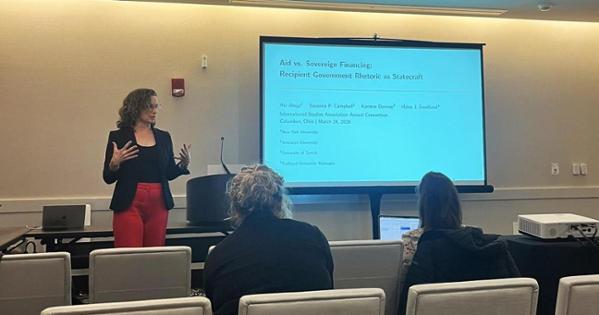 SIS Professor Susanna Campbell presented her current research project on why and how aid-recipient governments are using strategic communications to push back on aid from donor governments. While existing aid scholarship broadly assumes that aid-dependent governments want to appease donors, Campbell’s research shows how the variation in their aid rhetoric—rejecting donors, appearing to be neutral, or actively accommodating donors—is a form of statecraft. Looking specifically at how outside financing options shape aid-recipient governments’ willingness to confront donors in public during an electoral cycle, Campbell connects the politics of aid to sovereign borrowing, predicting that sovereign financing conditions determine whether recipient governments’ rhetoric turns confrontational or accommodating. In this way, Campbell’s research argues that recipient governments are strategic actors who publicly negotiate their aid bargain.
Shagun Gupta, “Aspirational Citizenship at the City’s Edge: Claim-Making and the Local State in Delhi’s Unauthorized Colonies”
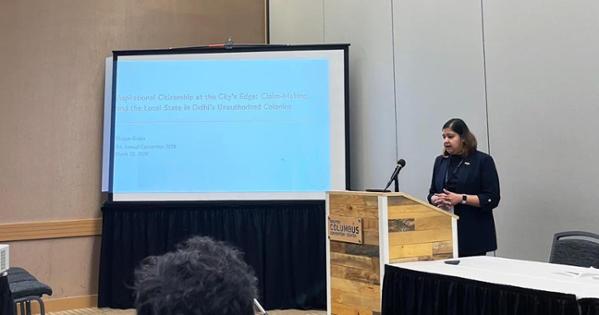 During the ISA session on governance, security, and participation in the Global South, PhD student Shagun Gupta presented her emerging research project “Aspirational Citizenship at the City’s Edge: Claim-Making and the Local State in Delhi’s Unauthorized Colonies.” Building off of her dissertation research with ethnographic fieldwork in Badarpur, Delhi, an “unauthorized” area near Delhi where large populations live beyond the formal city plan and have fragmented access to services, Gupta aims to explore what it means to be a citizen of a city in a new book project. With 30 colonies (neighborhoods) of Badarpur visited and 52 more planned, Gupta plans to dive deeper into how residents of unauthorized settlements imagine urban citizenship and how they might achieve that with the help of political party brokers and local associations.
Hrach Gregorian, “Culture and Trauma: Enhancing Practitioners’ Toolkit”
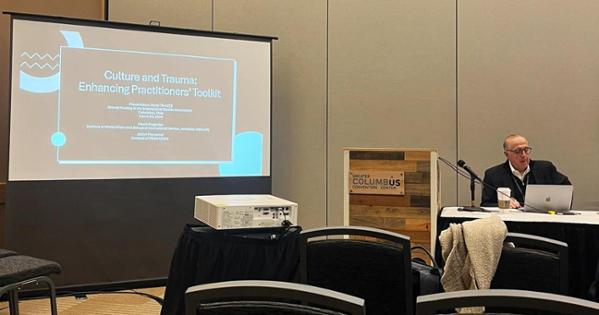 On a panel about the challenges associated with peace missions, SIS Professor Hrach Gregorian presented his paper “Culture and Trauma: Enhancing Practitioners’ Toolkit” examining how non-Western and indigenous cultures express trauma, and how such examples can help inform Western-trained peacekeepers working in those contexts.
Gregorian explained how trauma-informed peacebuilding is a critical component of effective war-to-peace transitions, as healing programs are essential to building social cohesion and reducing the possibility of a return to violence. However, the Western definition(s) and symptoms of trauma can be a narrow understanding that doesn’t apply to non-Western cultures in which people tend to understand trauma in spiritual or religious contexts and express trauma in more somatic rather than emotional ways. This understanding of the assumptions, expressions, and treatment for trauma in non-Western cultures has important implications for external practitioners.
Jeffrey Hallock, “From Revolution to Reform: Sustaining Anti‐corruption Efforts in Armenia”
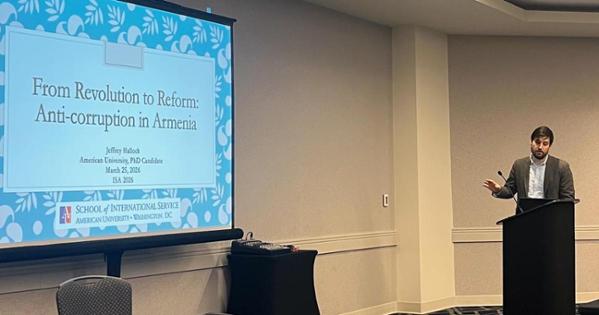 SIS PhD student Jeffrey Hallock presented his paper “From Revolution to Reform: Sustaining Anti‐corruption Efforts in Armenia” on the “Corruption, Trust, and Development in World Politics” panel, which examines how the Armenian government implemented anti-corruption reforms after the 2018 Velvet Revolution that brought Nikol Pashinyan to power. Using key stakeholder interviews, open government data, public statements, and secondary sources, Hallock completed an institutional analysis of Armenia’s anti-corruption framework, including its prevention mechanisms and enforcement mechanisms. He showed how Armenia’s multi-agency framework has qualitatively changed the nature and perception of corruption in the country, but it still has its shortcomings and has not fully “solved” the issue.
Jonathan Crock, “The Human Right to Anti-Supremacist Democracy”
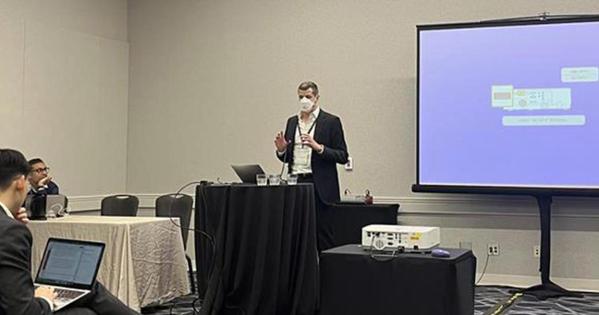 In one of the final panel sessions of ISA 2026, SIS Professor Jonathan Crock outlined the need for citizens’ assemblies or another alternative in order to end the supremacist structures inherent to existing democratic institutions. In his paper “The Human Right to Anti-Supremacist Democracy,” Crock explains how even in the best democracies, human rights are violated through electoral institutions: it is the right of all marginalized people to have an equitable share of power and governance, but elections are steeped in existing power structures and inequities and so do not provide such equity.
Instead, Crock argues, we need new governing solutions based in human rights law. One such tool is using citizens’ assemblies, which are a randomly selected body of citizens who are empowered to hear from experts and make binding policy decisions, to augment and eventually replace electoral governance. Citizens’ assemblies meet human rights requirements because the makeup of the assembly matches the makeup of the country as a whole, and they have an empirical record of success in places like Ireland, Iceland, Mongolia, and France. The first step, Crock says, is to recognize the citizens’ assembly as a legal right, and then mobilize to achieve it.