
SIS Student Presents Recommendations to Prevent Youth Recidivism at United Nations in Vienna
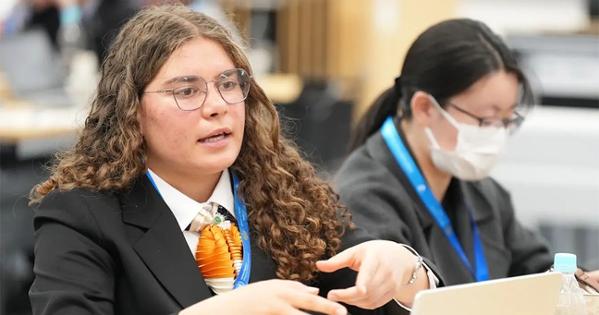
In a testament to the power of student research and youth voices, Coralie Arias, SIS/BA ’28, recently had the opportunity to present recommendations aimed at preventing youth recidivism at the 35th United Nations Commission on Crime Prevention and Criminal Justice in Vienna.
Arias is a Sakura Scholar—the name given to American University (AU) students pursuing a Bachelor of Arts in Global International Relations, a joint degree program between AU’s School of International Service (SIS) and Ritsumeikan University (RU) in Japan. It’s the first program of its kind between a US and Japanese university.
Arias’s path to Vienna began in March, when she was chosen to co-chair the fourth Global Youth Forum for a Culture of Lawfulness in Tokyo—an annual youth summit hosted by the UN Office on Drugs and Crime (UNODC) and Japan’s Ministry of Justice. Arias first heard about the youth forum while studying at RU, where Sakura Scholars complete part of their joint degree.
Alongside 84 participants representing 43 countries, Arias and students from around the world gathered in Tokyo after months of research to develop recommendations on ways to prevent recidivism and help reintegrate previous offenders and formerly incarcerated persons back into society.
“The United Nations considers youth to be anyone from ages 18 to 30, so everyone was from different backgrounds and had different perspectives,” Arias said. “There were undergraduate students, graduate students, lawyers, people who have a lot of experience, and people who have less experience. As co-chair, I wanted people to feel comfortable enough to have a voice and feel like they could speak on what they had researched.”
 From the discussions during the three-day forum, the group of youth participants developed three recommendations for the UN. First, media organizations, governments, and civil society should reexamine how they portray and refer to previous offenders and formerly incarcerated persons to confront social stigma and discrimination. Second, governments, universities, and service providers should foster more rehabilitative and reintegrative environments. And finally, rehabilitative programs should be tailored to the needs of vulnerable groups of previous offenders—including youth, women, immigrants, ethnic minorities, and individuals with special needs.
Arias presented these recommendations at the conclusion of the youth forum in Tokyo and was later invited to travel to Vienna to present them at the United Nations Commission on Crime Prevention and Criminal Justice in June.
Reflecting on her presentation to the UN commission, Arias described the experience as “surreal.”
“I was in the place that people dream of being in, and I had done a lot of work leading up to it, so I was really grateful for the opportunity,” Arias said. “We have a group chat of participants from the youth forum who texted me that they were watching my speech from UN TV at a sushi restaurant, and it just made me feel like people were supporting me. I wanted to make people proud, and I wanted to embody a good presentation while representing Japan.”
Thinking about her time in the Sakura Scholars program and her experience studying at RU, Arias said she has appreciated how the experience has emphasized a global international relations perspective.
“I think sometimes when you’re in the US, you’re in a bubble and you’re getting one perspective,” said Arias. “Being in Japan has really allowed me to meet new people, discover a new culture, and get out of my comfort zone.”
Watch Arias’s presentation to the UN commission, starting at minute 28.