
How Research Took SIS Grad Students to the United Nations
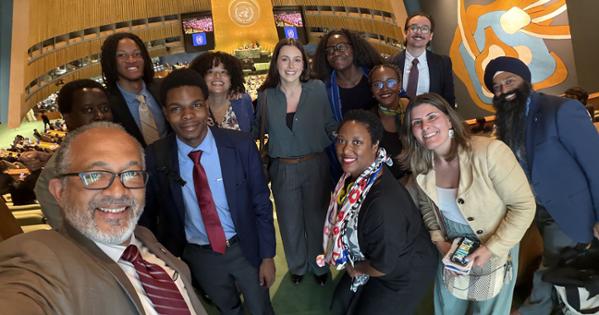
On June 9th, SIS and Kogod professor Derrick Cogburn led a side event at the United Nation’s 19th Conference of States Parties to the Convention on the Rights of Persons with Disabilities (CRPD) to officially launch and demonstrate the CRPD Disability Rights Data Dashboard that Cogburn and his team of research associates developed to evaluate the implementation progress of the CRPD across 170 Member States.
Cogburn, who serves as the Executive Director of the Institute on Disability and Public Policy (IDPP), enlisted the help of five American University students to develop the dashboard. John Dylan Bustillo, a master’s candidate in International Affairs Policy & Analysis, and Ana Kilbourn, an incoming master’s candidate in International Development, are two SIS students hard at work on this project.
Among other tasks, Bustillo contributed to the conceptual development of analytical tools available on the dashboard, prepared presentation materials for events, and led interviews to collect data for the team’s research study. He also had the opportunity to travel with Cogburn and members of the IDPP team to the UN in June to attend the side event launching the CRPD data dashboard and mobile app. Kilbourn is CITI-certified in the Responsible Conduct of Research for Administrators and Social and Behavioral Research and is preparing to interview representatives from organizations or individuals who would find the CRPD dashboard useful in their work.
We asked Kilbourn and Bustillo a few questions to learn more about their participation in this research project and how the work has helped inform their own research and career paths after SIS.
- How did you first get connected to this project, and what drew you to research at the intersection of disability rights and technology?
- Bustillo: When I began my studies at SIS, I was paired with Dr. Cogburn as a research assistant because of our shared interest in using artificial intelligence to address global challenges. As I became more involved with the Institute on Disability and Public Policy, I was drawn to the task of democratizing access to analysis of the CRPD. In particular, my own experiences made the intersection of disability advocacy and technology a particularly meaningful area of research. As a cancer survivor, physical mobility had been a long-term challenge, so working on a project that supports the transition from participation to meaningful representation deeply resonates.
- Kilbourn: As an International Development student, I am drawn to how technology, security, and human capital development intersect to produce measurable improvements in local employment, financial empowerment, and community resilience. Through conversations with Dr. Cogburn while a prospective student about my program goals and his work developing and expanding a user-friendly CRPD dashboard, I came to recognize that my interest in digital transformation extends to disability rights, particularly how digital tools strengthen inclusive governance, evidence-based advocacy, and community resilience. Coming from a nonprofit background, I am eager to examine how operational systems, supported by easy-to-use technology and robust data, enable organizations to implement well-designed, mission-based interventions more effectively. As a research associate with IDPP, I hope to build expertise contributing to the development of analytical digital tools that help grassroots organizations identify implementation gaps more precisely.

- What was it like to join the UN side event launching the data dashboard and mobile app in person? Was there a moment that felt particularly meaningful?
- Bustillo: As an SIS student, it was a singular experience to join the IDPP delegation as we and thousands of advocates, world leaders, and Organizations of Persons with Disabilities gathered at the UN to celebrate the 20th anniversary of the CRPD. Considering this background, the launch of the data dashboard and revamped mobile app captured the spirit of one of the Conference’s major themes: “Enhancing Accessible Civic Engagement, Leadership, and Advocacy in Political and Public Life.” It was a real pleasure to see how excited members of the disability community are about the dashboard, and how it can be incorporated into their advocacy.
- Over the course of the conference, I had the opportunity to showcase the data dashboard to a number of advocates. It was these interactions that I found particularly meaningful. Coming from countries around the globe, everyone I spoke to brought a rich perspective to disability advocacy that broadened my understanding and provided countless learning experiences. I also profited from hearing the unique perspectives on how different segments of the disability community could incorporate the potential insights from the dashboard into action.
- What is something you contributed to this project that you're especially proud of?
- Bustillo: An ongoing contribution I am especially proud of is supporting the user-validation process for the dashboard. Gathering feedback from members of the disability rights community is a crucial step for ensuring that the platform is accessible to the diverse stakeholders it is designed to serve. To assist in this effort, I engaged in both participant recruitment and user-validation sessions. Helping connect the project with individuals whose perspectives were essential to evaluating the dashboard not only made it more responsive to the needs of advocates, researchers, and persons with disabilities, but also raised awareness of this powerful toolkit we have developed.
- Kilbourn: While I am still early in my involvement, I am proud of how quickly I was able to understand the CRPD dashboard’s goals. I am, for the first time, CITI Program-certified to conduct interviews with representatives of Organizations of Persons with Disabilities. This past month, I helped a teammate develop a flyer for our side event at COSP.

- How has your work on this project and with the IDPP helped you grow as a student and as a researcher?
- Bustillo: It has been amazing to work with Dr. Cogburn and the rest of the IDPP team on making the dashboard an instrument for knowledge translation. Through this project, I learned a great deal about how to filter technically dense information into something that is visual, searchable, and intuitive for analysis. It has been rewarding to see how this project has sought to marshal the immense amount of information generated by the treaty reporting cycle for use by the disability rights community.
- As a student, I have found that this experience has challenged me to critically engage with human-centered design thinking and communication with both technical and non-technical audiences. In a similar vein, this project highlighted the need for researchers to engage stakeholders throughout the research process. Overall, my work with IDPP has encouraged me to develop the skills to apply AI methods to complex datasets and the confidence to remain attentive to the broader social impact of the work.
- How has working on this research shaped the way you think about your own academic work or career path?
- Bustillo: A perspective reinforced by this research is the value of using NLP, machine learning, and generative AI methods as interventions to make information locked in extensive text-based documents usable for decision-makers. Seeing the potential for AI tools to support disability rights advocacy, I hope to apply the lessons learned to a range of complex global problems. More broadly, the experience deepened my interest in learning how to leverage AI tools in my career to support more informed decision-making.
- Kilbourn: I applied to SIS to gain real-world, practitioner-focused experience, and my role as a research associate with IDPP has clarified what I aim to focus on in my studies: to help translate data into decisions that organizations, governments, and businesses can actually act on.