
Meet Undergraduate Student Speaker Melia Hawthorne Klingler
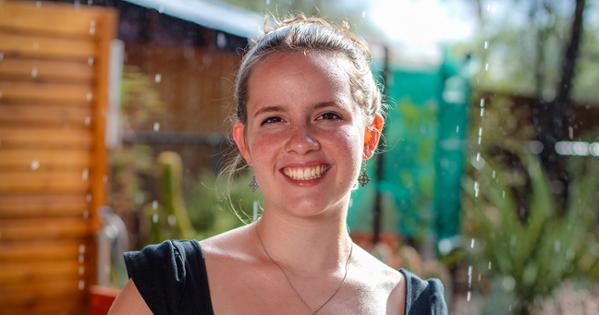
There are myriad ways in which people find their way to the study of international affairs. For Melia Hawthorne Klingler, SIS/BA ’26, that interest began in childhood.
The daughter of a Spanish language professor, Klingler grew up between Costa Rica, Mexico, and the United States. She credits living abroad with instilling an appreciation for other cultures.
“My parents lived abroad when I was born, and then we did multiple times as a family as well,” Klingler shared in a recent interview. “I’m a bit of an introvert, and as I’ve gotten older, I’ve realized how those experiences of living abroad not only taught me a lot about others, but about myself as well.”
Klingler has been selected as the undergraduate speaker for this year’s Commencement on May 9. We recently sat down with Klingler to learn more about her background, her time at SIS, and plans for after Commencement.
Where Faith and Peace Meet Foreign Policy
In addition to growing up abroad, Klingler was raised in the Mennonite church—a Christian denomination that emphasizes pacifism and peace. When considering universities, Klingler said she was looking for a place where she could “integrate international studies with peacebuilding.”
With its top-10 ranking for undergraduate international affairs studies and longstanding peace and conflict resolution curriculum, SIS proved the perfect fit.
At SIS, Klingler found a way to combine her interests in peacebuilding, religion, and international affairs through various courses and research opportunities. During her freshman year, Klingler took a culture and religion class with Professor Mohammed Abu-Nimer. The class, which focused on using faith to build understanding between people, ultimately inspired Klingler to apply what she was learning outside the classroom through the American University Interfaith Club, which she co-founded with fellow student Taha Vahanvaty, SPA/BA ’26.
“I met [Taha] in my freshman dorm. He is Muslim, and I am Christian, and we just started having these interfaith conversations,” Klingler recalled. “We decided to start the interfaith club together. And I feel like interfaith work and SIS coursework complement each other, so it's been great to be able to bring examples from interfaith work and from different experiences into SIS, but then also bring knowledge from SIS into my interfaith work.”
Finding a Research Focus
At SIS, Klingler also found a way to apply her interests and involvement in interfaith work to research.
While Klingler was building community among students of various faith backgrounds on campus, she became increasingly concerned about the rise in Christian nationalism across the U.S.
“I'd hosted a Christian intrafaith dinner where we invited all the Christian groups on campus. So, we had some Quakers, Orthodox, Catholic, non-denominational, all kinds of Christians,” Klingler said. “And just like seeing that dialogue and seeing how much richness there is within this community, I became really interested in looking more into the Christian community. At the same time, I was also becoming a little concerned about Christian nationalism, so I considered how I could maybe put these pieces together and study Christian nationalism and polarization.”
Klingler research included two parts—one that included talking to Christian pastors across the political spectrum to understand their approaches to politics, and a second that involved speaking to Christian nationalists to understand their perspectives and the growing movement.
To complete this research, Klingler applied, and ultimately was selected, for the prestigious Obama-Chesky Voyager Scholarship, which provides financial aid and travel stipends for research. She used the funding to travel to a Christian nationalist conference to observe and interview attendees and spend last summer in Arizona conducting interviews with pastors.
Klingler compiled her research during the Fall 2025 semester. Through analysis of the dozens of interviews she conducted, Klingler found that no matter where faith leaders fell on the political spectrum, their framing of their political beliefs was similar.
“Everyone viewed their political beliefs not as something coming from the world, but actually something directly emanating from their faith,” Klingler said. “And so there’s this idea that it’s not politics; it’s faith leading their political stance.”
Klingler ultimately presented her findings this spring at the National Conference for Undergraduate Research as part of a delegation of five SIS students. She credited her SIS courses—especially her ethnographic research class with Professor Douaa Sheet—with giving her the practical tools and confidence to conduct effective research interviews.
“That was one of the best classes I have taken to this day,” Klingler said. “That really taught me how to practically conduct interviews, obtain consent, and make sure people were comfortable during the interview. That class really gave me the confidence to feel like I could go out and do this kind of research.”
To Commencement and Beyond
Through her speech at Commencement, Klingler plans to talk about maintaining hope in challenging times. Amidst rapid shifts at the federal level—including the shuttering of USAID and the United States Institute of Peace—Klingler said she wants to talk about her journey of “trying to find hope and a way forward in a very difficult time.”
“I plan to talk about how we can take what we’ve learned at SIS and move forward with that, all while trying not to become too cynical,” Klingler said.
After graduation, Klingler says she hopes to continue producing research with a specific focus on conflict resolution and ultimately create “better frameworks for communities to engage in dialogue and peacebuilding.”
Reflecting on her years at SIS, Klingler said her studies have opened her eyes to new perspectives that will stay with her after graduation.
“I think a lot of my SIS experience has been like, ‘Oh, I had this opinion, and then I take this class, and now I have a new way of understanding,’” Klingler said. “It’s given me a sense of nuance and an understanding that maybe there's not a definitive answer and there’s not just one way to view a situation.”