
SIS Students Present Research at National Conference on Undergraduate Research in Richmond
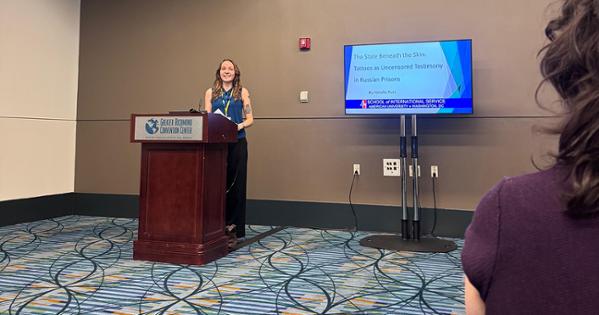
From April 13-15, 2026, a five-member delegation from American University’s School of International Service (SIS) traveled to Richmond, Virginia, to participate in the National Conference on Undergraduate Research (NCUR). The conference brought together undergraduate researchers from across the United States to present original scholarship, engage in interdisciplinary dialogue, and connect with peers and faculty from a wide range of institutions.
The AU delegation represented a range of research interests within SIS, contributing to conversations spanning international politics, economics, history, and religion. Students shared their work while also engaging with research in fields such as environmental science, archaeology, public policy, and artificial intelligence.
For the SIS delegation, NCUR offered an opportunity to participate directly in a national academic forum and to engage with emerging scholarship across disciplines. In addition to presenting, students attended professional development sessions.
To hear more about the experience, we asked Natalie Putz, SIS/BA ’27, to share a few reflections.
Natalie’s Reflections
In April, I had the opportunity to represent American University at the National Conference on Undergraduate Research (NCUR) in Richmond, Virginia. The conference brought together undergraduate students from across the country to present research and engage with a wide range of academic topics and perspectives.
My research exa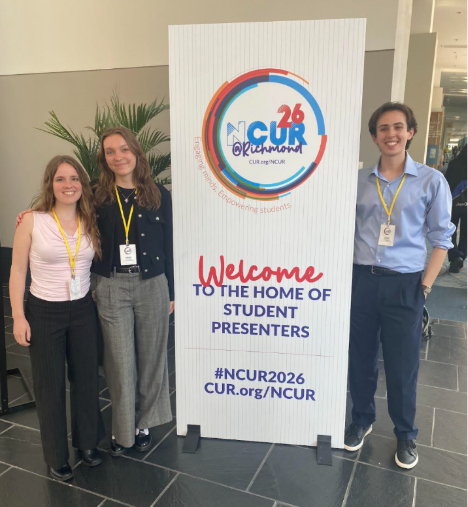 mined the emergence of Russian prison tattoos as a discourse of resistance in post-Soviet Russia. Once targeted for erasure under the Soviet Union, these tattoos have persisted and evolved into a complex visual language that communicates identity, authority, and belonging. Originally rooted in codified prison hierarchies, they functioned as records of status and experience, but over time developed into a broader semiotic system conveying moral codes, survival strategies, and forms of resistance within highly controlled environments.
By coding motifs, placement, and meaning, I examined how these symbols operate both within prison systems and in wider society. My findings point to a paradox: in the context of increasing state control and declining trust in official narratives, the symbolic system of the criminal subculture can function as a more stable and legible form of communication. In this sense, prison tattoos serve not only as markers of identity but also as carriers of collective memory and alternative political meaning.
Presenting this research at NCUR was one of the most valuable parts of the experience. While I had presented in classroom settings before, the conference environment required a different level of confidence. Sharing my work with other professionals required me to sharpen my argument and respond more directly to questions. And the feedback I received encouraged me to think more critically about how to expand my research in the future.
My coursework at SIS played an important role in preparing me for this opportunity. Classes at AU, particularly SISU-206 and SISU-306, which emphasize research design, international relations theory, and qualitative methods, provided the foundation for developing my methodological approach. At the same time, as part of the Global Scholars Cohort, I benefited from a close-knit and intellectually engaged classroom community that consistently pushed me to refine my ideas. That environment was essential in helping me identify a research topic that felt both meaningful and well-grounded. This was ultimately what enabled me not only to carry out my research effectively but also to grow as a scholar.
A big thanks to Dr. Boesenecker for all the help preparing for this conference and to Dr. Hardig for leading our cohort classes!