
Advancing Girls’ Education: An SIS Alumna’s Path to Global Philanthropy
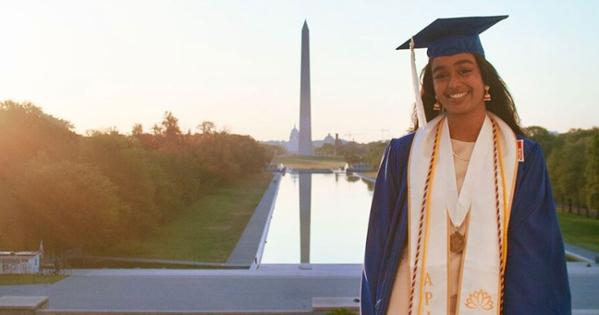
Dhanya Rao, SIS/BA ’21, has built her early career at the intersection of girls' education, gender equity, and international development—work that traces directly back to her time at American University’s School of International Service (SIS). Today, she serves as an individual giving officer at Malala Fund, a nongovernmental organization (NGO) founded by Nobel laureate and Taliban survivor Malala Yousafzai that is dedicated to ensuring all girls can access and complete 12 years of education. Rao’s path began as a Malala Fund intern the summer before her junior year—one of several formative experiences that also included rigorous undergraduate research with Professor Malini Ranganathan and a study abroad program in Nairobi, Kenya.
In this Q&A, Dhanya reflects on the professors, classes, and opportunities that shaped her trajectory—from a professor that reframed how she thinks about global inequity, to an internship in Kenya that introduced her to grant monitoring, and the lessons in self-advocacy and risk-taking that continue to guide her and her work today.
- Tell me a bit about your work at Malala Fund and what feels most meaningful about it.
- I work on development at Malala Fund, primarily with individual donors who are really passionate about girls’ education and equality around the world. My work is really being the connective tissue between passionate individuals—primarily in the United States and the United Kingdom—to the girls and grantee partners that we are supporting on the ground in six countries. I think one of the best parts of my job is seeing donors rise to the occasion and fund boldly with their values, especially as institutions and commitments to a global future have rescinded or declined in recent years. For example, after the fall of Afghanistan, after the Taliban takeover, we had some incredible donors step up to support our evacuation efforts and have continued to support our advocacy around Afghanistan. Most recently, in the wake of the United States Agency for International Development (USAID) closure, we've had donors step up to ensure the projects that we support around the world can continue to go on without issue.
- How did SIS impact your career goals and trajectory?
- I came to SIS in 2017, and all I knew going in was that I wanted to work internationally and have something to do with gender. SIS gave me the support and direction I needed to turn that small inkling of an idea into a reality and into a career. I think the best thing that SIS gave me was the rigor needed to unpack issues of inequity and injustice around the world and really understand what it takes to dismantle it. I think the specific areas of SIS that have spoken to this are the research curriculum for the undergraduate education. Those early courses were foundational in helping me understand how to ask the right questions in a research project, but also in my work—the right questions to understand what a donor's interests are, why they're coming to this work, what sort of impact they'd like to make. All of that is translated so beautifully. I also did a minor in economics, which helped me understand the world and apply a different lens to some of my work, take the theories out of class, and back things up with real-world examples.
- Was there a particular class or professor that really stuck with you?
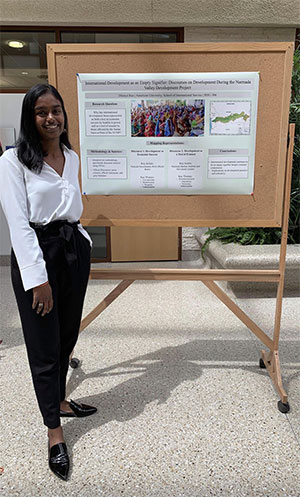 Without a doubt it was Professor Malini Ranganathan. I took her class Environmental Sustainability and Global Health. Her class is a real example of turning conventional assumptions in international relations on their head. She was the first person who helped me understand the political factors, and not necessarily scientific factors, that cause things like famines and population control. When she talked about famines, for example, it wasn't that there just wasn't enough food for everybody to eat; We took that investigation one step further. Why wasn't there enough food to eat? It was because of colonialism and damage and the economic systems that took food out of countries and back to the colonial core. So, the way that she framed lessons and the way that she encouraged me to think and question the things we take for granted has stuck with me since then.
- I had a really great opportunity to work one-on-one with her on my SIS honors thesis, and that was incredibly meaningful. I got to take so many of the concepts she taught me my sophomore year and actually translate them into my own research. So, to go from her being my professor my sophomore year to becoming more like my thought partner and collaborator my senior year was incredibly full circle.
- Do you have a favorite memory from SIS that you'd like to share?
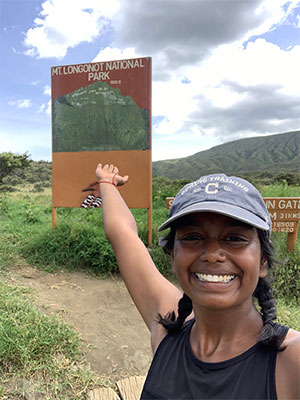 My favorite memory, without a doubt, was studying abroad at AU Nairobi. I had such a great time. It was one of the reasons that I wanted to go to AU in the first place. It was one of the few schools that actually had a study abroad option in the continent. So as a junior, taking some of my knowledge that I had learned as a freshman and sophomore and being exposed to some of the on-the-ground realities while learning from experts and practitioners from the continent and in Kenya was amazing. I also had a chance to get immersed in the local culture with the host family, who was just amazing. I got to travel with a lot of my friends. But I think most meaningfully for my professional outcomes and career, I was able to intern for a local NGO called the Center for Domestic Training and Development, which trains women in informal settlements across Nairobi through domestic work as a pathway for employment. And my role as an intern was on the monitoring and evaluation end. So, I got to do some qualitative research surveys to understand how effective the programs were and take some of those learnings into grant proposals and reports. That was kind of my first experience working on grant reporting, which is something that I do all the time in my job right now. To be trusted to take on that work and to be seen as a top partner for this organization was really meaningful and helped me understand how much I wanted to continue working on gender in international development.
- What was the most valuable thing you learned during your time at SIS?
- For me, it was learning a) how to advocate for myself and b) how to seize the opportunities that came my way. When I was a student, I was hustling all the time. I was taking a full course load, I was working a part time job, I was involved in student organizations, I was interning during the school year. Each of those opportunities encouraged me to grow in very specific ways. And by taking on those opportunities, I was able to actually understand what I was interested in. The sophomore-year research curriculum really inspired me to continue research and use my writing skills to investigate the things that I was curious about in the world around me. I had a really close cohort of students who challenged each other, and we did incredible independent research during COVID-19 when the last thing we wanted to do was turn on our laptops and take on really heavy writing and research projects. But it was a great opportunity and a great learning experience for me.
- As I left SIS, I knew the only way to learn and to grow is to challenge yourself. SIS was a really safe environment for me to be able to take risks, but now outside of SIS, I’m still taking those risks and learning from them and understanding more about myself each and every day.