
How One MAIR Student’s Advocacy Work Found an Audience at SIS, Starting With Her Professor
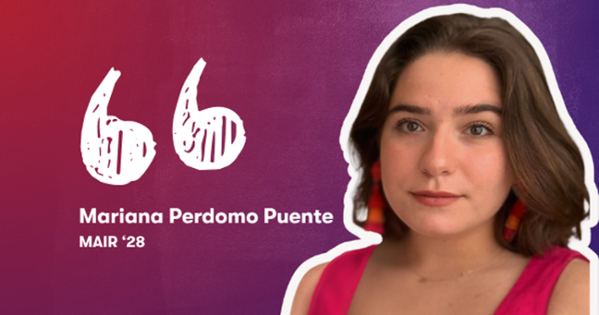
A conversation with MAIR student Mariana Perdomo and Adjunct Professor Frieder Dengler
When Adjunct Professor Frieder Dengler read Mariana's published essay, "The Names That Keep Marching," he reached out to ask if her work could be featured. She hadn't expected him to read it at all.
Mariana Perdomo Puente enrolled in the online Master of Arts in International Relations (MAIR) program at the School of International Service this past spring with her advocacy already underway. A Venezuelan exile, she co-founded Criollistán, a blog giving voice to young people living under political repression around the world, and had already written an essay on Venezuela's 2014 protests that was circulating among readers before it reached us. It got there through Adjunct Professor Frieder Dengler, who taught Global International Relations this past spring and read Mariana's essay after a student passed it along. He read it, reached out, and asked whether we had a place to feature it. We asked both of them about that exchange, and about what the MAIR program has meant to her work outside the classroom.
- Tell us about Criollistán: what is it and why did you start it?
- I started Criollistán early this year alongside two dear friends of mine. Though we had the idea for this project, we hadn't given it too much thought until we realized there were integral voices missing from geopolitical analysis — the voice of those on the ground or in exile and of younger generations. Our objective has not changed, and this is mainly focused on reaching out to other younger people from other countries whose voices we do not hear from. We have already made contact with young Palestinians in Gaza, young Kurds from Rojava, Ukrainians surviving the winter, Cubans living through one of countless energy blackouts, Iranians in Tehran, and we've even been contacted by a young Sudanese woman. Criollistán is a space made for real solidarity to combat the waves of censorship enacted in many of our countries. We believe our struggles may not be so different after all.
As for its impact on the Venezuelan community of exiles abroad, it has been very well received — especially among younger Venezuelans in and out of the country who have lived a life of political uncertainty and persecution. They have communicated that this outreach project has given them the means to share their experiences, as well as their own analysis of the situation on the ground.
- Your essay on the 2014 protests is called “The Names That Keep Marching.” What compelled you to write it, and who were you writing it for?
- I lived through the 2014 protests in Venezuela, or “guarimbas,” as they are better known in Venezuela. Having been raised in a home of women where debates were held, and even encouraged, I had a sense of justice instilled in me from a very young age. As such I marched and protested alongside others during this time, and experienced firsthand the brutality by the hands of repression and security organs in Venezuela. Having lived through this and more, as the anniversary of the beginning of the 2014 “guarimbas” drew nearer, I felt compelled to write about it because I believe it reshaped the Venezuelan psyche, and proved to be a turning point in the relationship between younger Venezuelans and the state. I wrote it for myself, yes, but also for those who are no longer with us but whose names and faces we still march for. Thus came the name “The Names That Keep Marching.”
- Professor Dengler, how did you come across the essay?
- I would not have known about Mariana's writing had it not been for another student sharing that she had published something. Students should absolutely feel encouraged to share such things with faculty, because it is exciting for us to see and also provides additional context to the students' involvement and performance in class.
- What did you find when you read it?
- When I read the essay, it convinced me through the clarity with which it conveyed aspects of the protests and thoughts about the anti-government movement in Venezuela in 2014, especially the role of youth, that are lost in the usual reporting on the issue. The essay makes some fascinating and really strong points about the multiple dimensions of these protests, including providing a three-fold framework for understanding the legacy of the conflict on the politico-institutional level, the socio-cultural level, and the symbolic level. I was especially fascinated by Mariana's articulation of the idea that, for Venezuelan youth, protest participation had become a way of manifesting one's presence in a fundamentally hostile and restrictive environment.
- You taught Global International Relations this past spring: did the essay connect to the course?
- Mariana was a student in my Global International Relations Course this past spring, a course designed with the explicit goal of freeing the study of international politics from its traditionally Eurocentric gaze. Mariana's essay achieves that by highlighting the agency and power of actors and ideas that are often forgotten or ignored. There are even direct connections to the course topics. In her essay, Mariana writes about how power operates through ways other than repression and coercion, which is a way of thinking about power common to some of the theories we explored in the class. In that sense, I definitely see her work as being connected to the course. I believe Mariana's writing reflects a dedication to not only better understanding our world but making it a better place. It is exciting that we are able to continue attracting such students to AU.
- Mariana, what did it mean to find out Professor Dengler had shared your work with the Online and Executive Programs team?
- It was incredibly meaningful. I had shared Criollistán with a classmate and they shared my writing. I hadn't expected Professor Dengler to read it, let alone like it! After this experience I feel much more confident and comfortable in approaching members of faculty that I believe could guide me both academically and professionally. Based on my own experience in an online program I don't really see a difference between being in-person and online concerning faculty relationships. It just takes one moment of bravery to reach out!
- Has that connection opened anything up for you going forward?
- Yes, I've had great conversations with Professor Dengler following this, and I have decided to apply for a Fellowship.
- Professor Dengler, what does this exchange say about student-faculty connection in an online program?
- The student-faculty dynamic in the online program is greatly muted compared to in-person classes. Finding out about Mariana's essay offered a great opportunity to connect with her in a way that was not limited to the course content.
- Mariana, since joining MAIR, how has your academic training changed the way you research, write, or frame your advocacy work?
- I find myself more daring and adventurous. The curricula as well as the class structures have encouraged this as well. There is a real sense of camaraderie among the student body that I believe is critical in the way that it has pushed me outside of my comfort zone.
- Is there a specific course, theory, or skill from the program you've directly applied to your writing or organizing outside the classroom?
- The most influential course that I have taken so far, and that I also believe has allowed me to draw connections between various historical events in Venezuela, has been Global International Relations. This class overall has proven to be a welcome challenge when it comes to improving both my writing and synthesis skills.
- What would you tell a prospective student who is already doing meaningful work and wonders if a graduate program fits into that?
- My answer to them would be: it will enrich you in ways you've yet to realize. I find this answer encapsulates my own experiences at MAIR perfectly — graduate school has always been a goal for me, though I never believed I would be as committed and motivated as I am now. MAIR guarantees success because they care about both the student body as well as their own potential. I feel MAIR has not only inspired me, but it has also given me much credibility in my advocacy and the skills needed to continue excelling in my field.
Responses were submitted in writing and have been lightly edited for grammar and clarity.