
Holiday Energy Curtailment Results in Carbon Emissions Reduction Equivalent to Taking 63 Cars Off the Road for a Year
The first priority in American University’s carbon neutrality strategy is to reduce energy usage. The university’s annual, year-end winter energy curtailment efforts have proven to be very successful in addressing that objective—especially at a time of year when the campus is mostly empty. Now a 15-year tradition, AU’s curtailment efforts this past holiday season helped the university save a significant amount of energy.
As in years past, the holiday energy curtailment was a university community-wide effort. The AU community worked together to lower thermostats to 55°F, turned off non-critical lighting, unplugged non-critical equipment and appliances, closed all windows and doors to keep the cold out, and took many other energy-conserving actions to achieve considerable financial savings and environmental benefits.
The data collected and analyzed from this past year’s curtailment efforts show that in the two weeks between December 20, 2025 though January 3, 2026, the university:
- Saved 3.88 billion BTU’s of energy (gas and electric)
- Avoided 271 metric tons in carbon emissions (equivalent to taking 63.2 cars off the road for a year)
- Reduced energy cost by $92,084
In the 15 years since AU began the all-hands winter energy curtailment initiative, the university community’s collaborative efforts have helped save $930,634 in energy costs.
To measure the effectiveness and success of the winter holiday curtailment efforts, the Energy and Engineering team analyzed energy reduction through various sources. Using Atrius, an energy dashboard platform, the team was able to graph total energy consumption and generate heat maps that provide insight on energy usage in the various buildings to help improve Heating, Ventilation, and Air Conditioning (HVAC) system efficiency and performance.
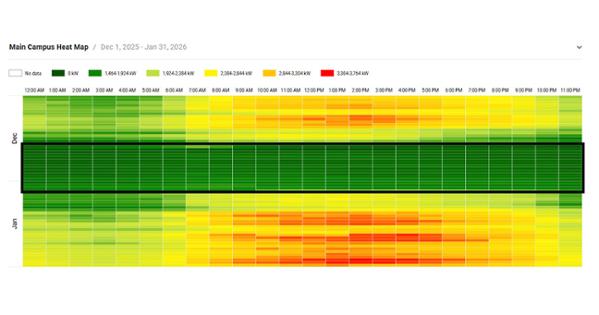
The Atrius heat map below shows the energy savings at AU during the holiday closure. Specifically, it shows the main electricity feed levels in color based on demand and need. Note that red is high usage, yellow is moderate, and green is low. The progression of shade from dark to light represents the variance within each. For example, dark green indicates the lowest usage where power was used only for essential lighting and heating, and other basic energy needs.
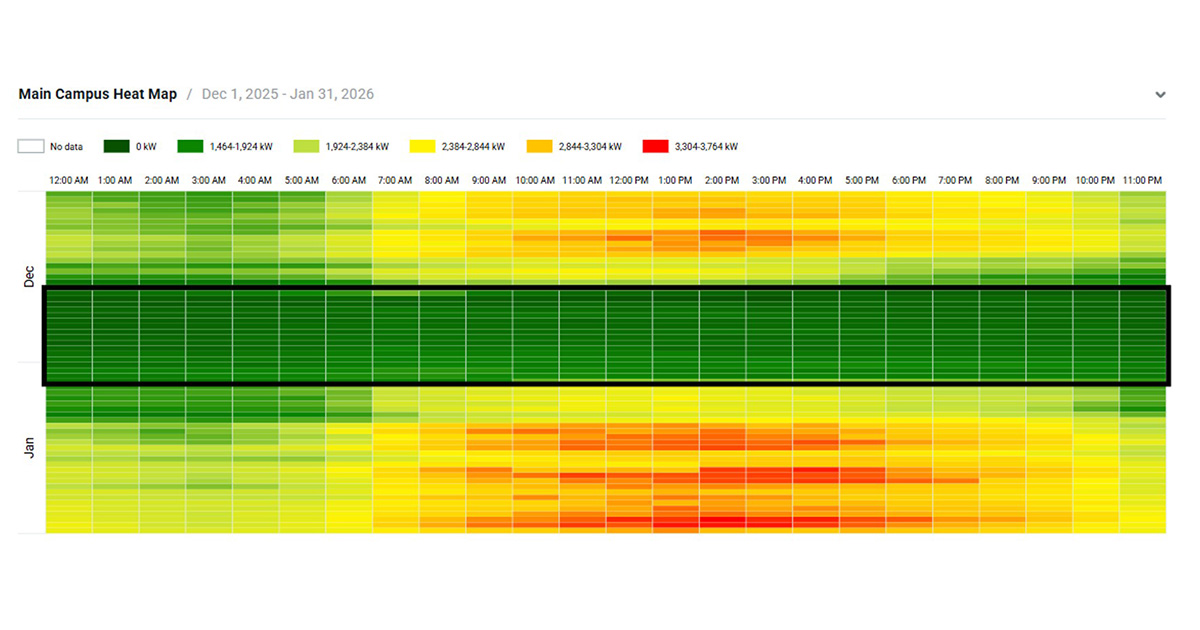
Energy use on campus during winter closure. The dark green indicates low use during the closure period.
“The energy curtailment efforts during our holiday shutdowns have proven to be an effective way for the university to save energy and money. However, our Energy & Engineering team makes saving energy a year-round effort, and it’s also something that the entire community can join us in doing throughout the year,” noted David Osborne, the Director of Energy and Engineering.
Here are some tips for what you can do year-round to help AU achieve energy savings:
- Shut off the lights if you are the last to leave your dorm or classroom.
- Use lamps, task lights, or night lights when the ceiling lights in your space are more than you need.
- Keep windows closed, as HVAC equipment is controlled most efficiently when outside air coming in is minimized.
- Unplug your electronics to reduce plug load during extended periods of time when they are not in use. A power strip helps bundle multiple items to aid in this task.
- Take shorter, cooler showers to help reduce the amount of water and the power used to heat the water.
- Wash your clothes in full loads without hot water as a way of reducing water and power usage.
- Call 2-Fix as soon as you see water leaking from a broken faucet or shower head. Also call if a toilet will not stop running water, or if lighting is not functioning properly.
“The Energy and Engineering staff thanks everyone who did their part to help the university save energy during this past winter break. With your help, we can save even more energy all year long,” said Tiffany Trang, Utilities Outreach Program Leader.