
Meltzer Center: AU’s First Net-Zero Facility, and On Track to Being Certified LEED Platinum
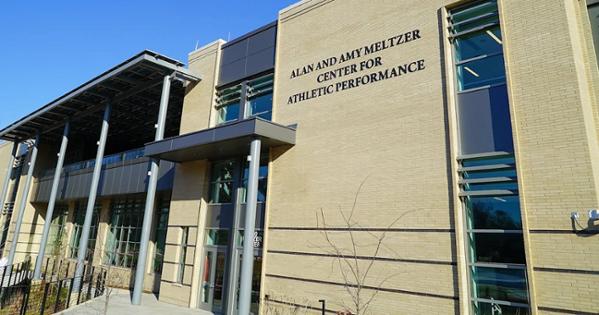
By now, everyone who’s walked through the American University campus has seen the new Alan and Amy Meltzer Center for Athletic Performance (Meltzer Center). The Meltzer Center is AU’s state-of-the-art competition, practice, and training facility. It was designed specifically to enhance the development of our student-athletes as well as bolster the overall recreational experience for the entire AU community.
While the Meltzer Center’s completion and ribbon-cutting mark the university’s first newly constructed athletics and health services facilities on campus in more than 30 years, its unique construction and landscaping are also worth noting and celebrating.
Powered entirely by renewable—solar and geothermal—energy, the Meltzer Center holds the distinction of not only being AU’s first net-zero facility, but it is also on track to being certified a LEED Platinum (Leadership in Energy and Environmental Design) facility. It has earned the maximum LEED points possible in the rainwater management credit and a LEED Exemplary Performance credit for rainwater management.
Rainwater Management
To address the issue of rainwater management, the Meltzer Center has 18,822 square feet of green roof space and features bioretention basins designed to minimize, capture, and absorb 100 percent of rainwater, even in the heaviest of rainstorms. The Meltzer Center’s use of drought-tolerant plants also reduces outdoor water use by 94 percent. Proper management of rainwater is critical, as runoff from urban locations such as AU’s campus can pick up pollutants and carry those pollutants into local waterways. It can also lead to local flooding and can cause erosion.
Landscaping
The grounds around the Meltzer Center expand the AU Arboretum by featuring an additional pollinator garden and native plants such as butterfly milkweed and black-eyed susans. The plants provide habitat and food for bees and birds, and do not need pesticides or fertilizers and require only minimal water.
“American University's entire campus is a certified Level II Arboretum and the landscaping at the Alan and Amy Meltzer Center for Athletic Performance truly reflects the commitment seen across campus to capture rainwater and expand native and adaptive species. The Meltzer Center’s native plantings and green roofs not only capture water during storms but also provide important habitat for native species. The space is a very exciting addition to the Arboretum!” said Megan Litke, Director of Sustainability.
Heat Island Mitigation
Also inherent in the Meltzer Center’s design are strategies to focus on habitat protection or restoration and the reduction of the effects of heat islands. Heat islands are “micro-climates” that occur when a developed area experiences higher temperatures than surrounding rural areas, or when areas experience hotter temperatures within a city. This phenomenon is the result of man-made features within urban areas absorbing more heat from the sun than surrounding areas that have more natural space. To mitigate the heat island effect, the Meltzer Center features street trees; light-colored, reflective pavement and roofing materials; and roof gardens, which include native and adaptive species.
Light Pollution Reduction
The Meltzer Center’s design aims to reduce light pollution using insulated windows, shielded lights and lamps, and exterior-shaded canopies. Exterior lighting was also specifically selected to have low BUG (Backlight, Uplight Glare) ratings, a lighting industry standard that rates outdoor fixtures based on unwanted light trespass and skyglow measured by light escaping backwards, upwards, and causing glare.
An added advantage to the low BUG-rated lighting is that it also reduces disruptions in the flight paths of migratory birds.
“Anything AU can do to reduce unnecessary lighting on campus and specifically to reduce or eliminate dangerous nighttime bird-window collisions is a good thing. The adoption of bird-friendly low-BUG lighting at the Meltzer Center will be beneficial to both local birds and seasonal migrant birds and will hopefully reduce nighttime window strikes resulting in deaths,” said Chris Tudge, Biology Professor, CAS.
The Meltzer Center is anticipated to achieve LEED Platinum certification later this spring.