
Physics Students Win Awards and Recognition at National Astronomy Conference
At the annual meeting of the American Astronomical Society (AAS) this winter, five American University undergrad physics students presented their research alongside scientists from around the world. They returned with awards, national recognition—and, in a rare highlight, a Sloan Digital Sky Survey (SDSS) plate, an artifact from a major astronomy project that had helped map the universe.
Abby Fisher, Henry Gray, Makaena Hewitt, Isabella Jones, and Simona Sotiri traveled to Phoenix for the meeting, accompanied by astrophysicist and American University Professor Johannes Ulf Lange. The event draws thousands of astronomers and astrophysicists each year, making it one of the field’s most important gatherings.
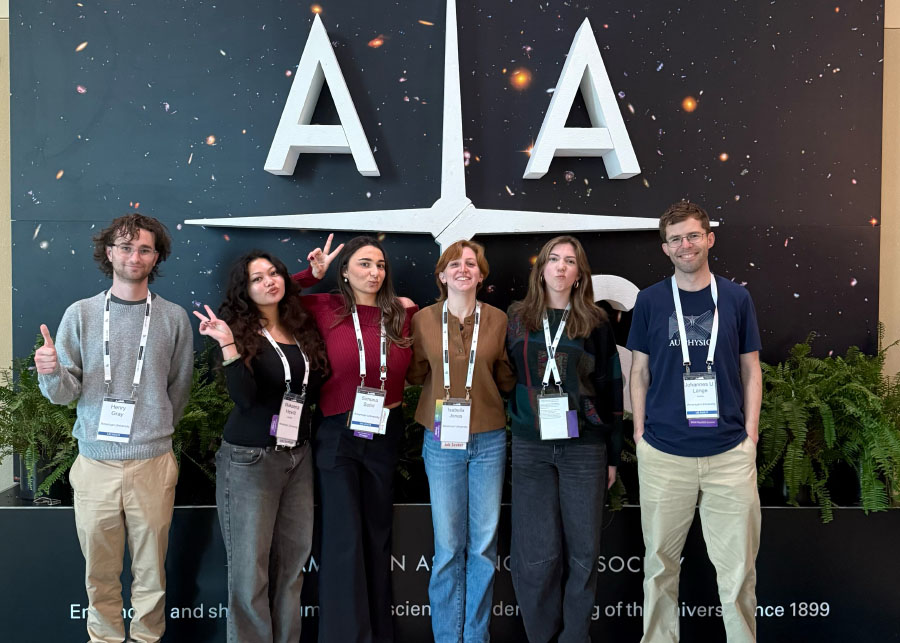 AU Physics Team (left to right: Henry Gray, Makaena Hewitt, Simona Sotiri, Isabella Jones, Abby Fisher, and Professor Johannes Ulf Lange)
For undergraduates, presenting at AAS offers a rare opportunity to share their work on a national stage. “The AAS is one of the most important meetings for the astronomy and astrophysics community. It’s also a great opportunity for professional development and networking,” says Lange, who supported travel for several students using his research funding.
The trip capped months of research, coding, data analysis, and rehearsing how to explain complex discoveries to rooms filled with professional astronomers. The students’ presence at the conference reflects the growing research opportunities within AU's physics program and the university’s expanding role as a Carnegie-designated R1 research institution.
Students Tackling the Universe’s Biggest Questions
The students presented research on some of the biggest mysteries in astrophysics and cosmology, from exoplanets to the accelerating expansion of the universe.
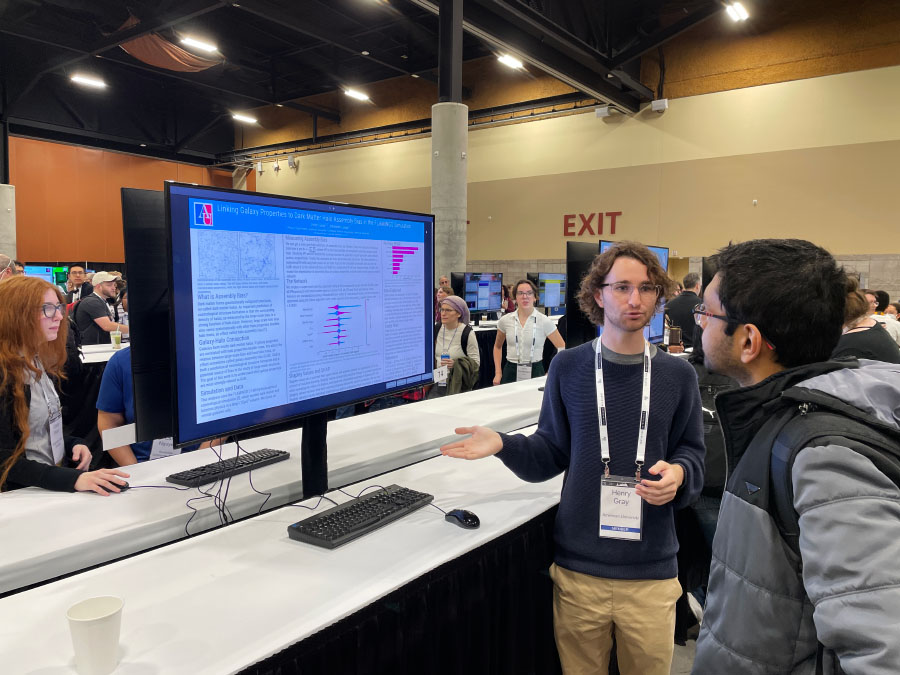
Henry Gray (BS computer science and physics ’26) presented a poster on the relationship between galaxies and dark matter using machine learning. He received an honorable mention in the highly competitive Chambliss Student Poster Competition—just one of 46 students receiving recognition out of 480 presenters. Gray’s research examines assembly bias in dark matter halos using machine learning techniques developed in collaboration with Lange. “This project was especially meaningful to me because it allowed me to combine my interests in physics and machine learning into a single research effort,” he says. “Discussing my research with other scientists helped me better understand how to communicate technical ideas clearly and strengthened my confidence presenting to academic audiences.”
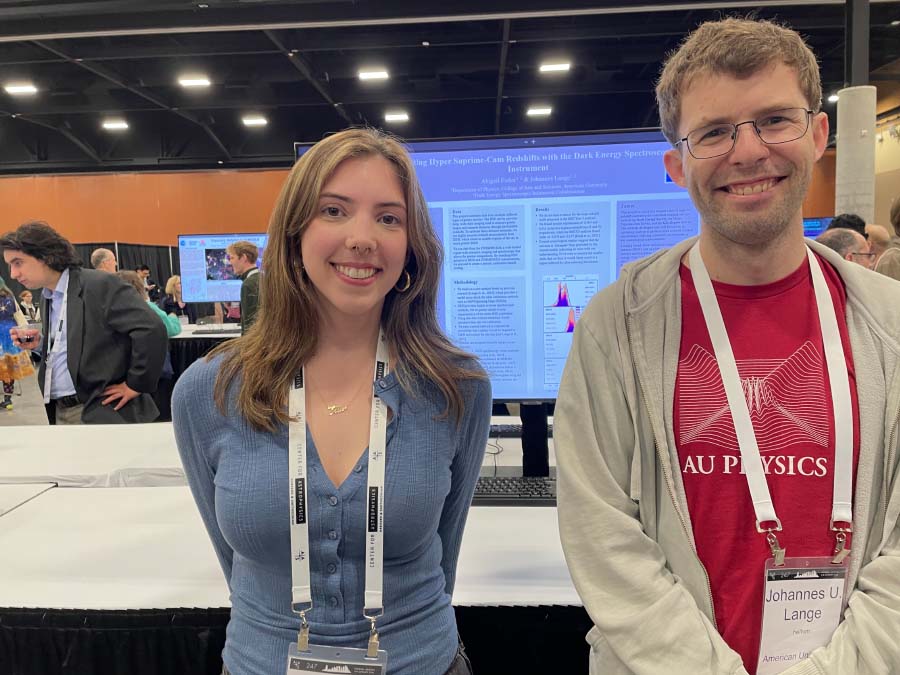
Abby Fisher (BS physics ’26) presented a poster on dark energy, the force driving the universe’s accelerating expansion. Her project, “Calibrating Hyper Suprime-Cam Redshifts using the Dark Energy Spectroscopic Instrument,” uses Python and machine learning to improve predictions from cosmological data. “This topic is extremely interesting to me because it directly relates to some of the biggest cosmological questions being asked today,” she says. “The part of the conference that stood out to me the most was getting to share it with my friends and fellow classmates.”
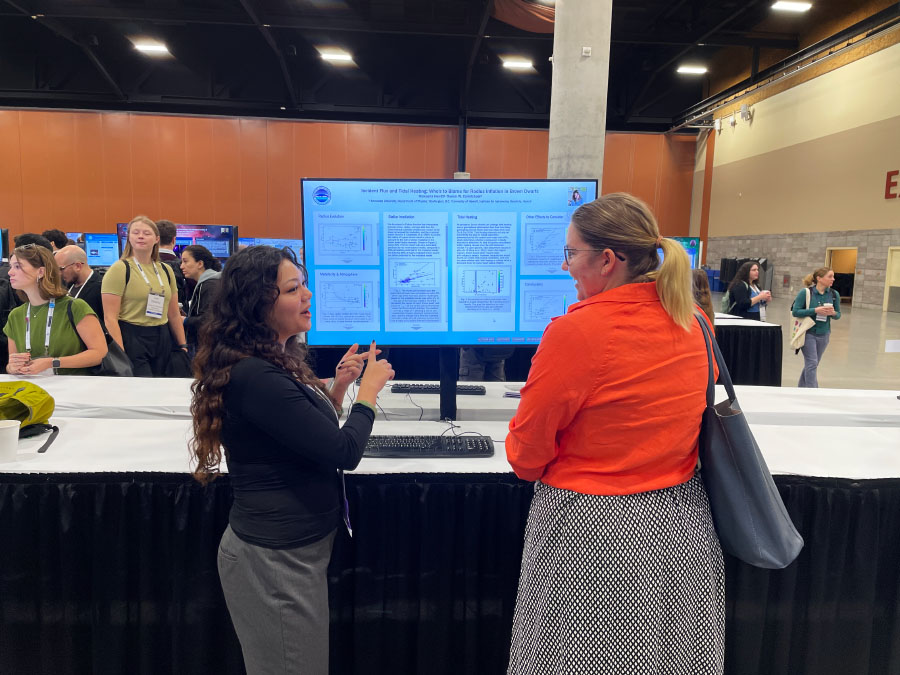
Makaena Hewitt (BS physics, BA philosophy ’26) presented a poster on brown dwarfs—objects that fall between planets and stars in size and mass. She developed a Python program that uses established models to estimate brown dwarf sizes based on mass and age, applying it to the 63 known brown dwarfs that transit their host stars. At the conference, she had the chance to meet the scientist whose models informed her work. “It was superb being able to talk with him about both of our work,” she says. “This experience, and Professor Babak Kasmaei’s mentorship and support, really motivated me to pursue more research opportunities.”
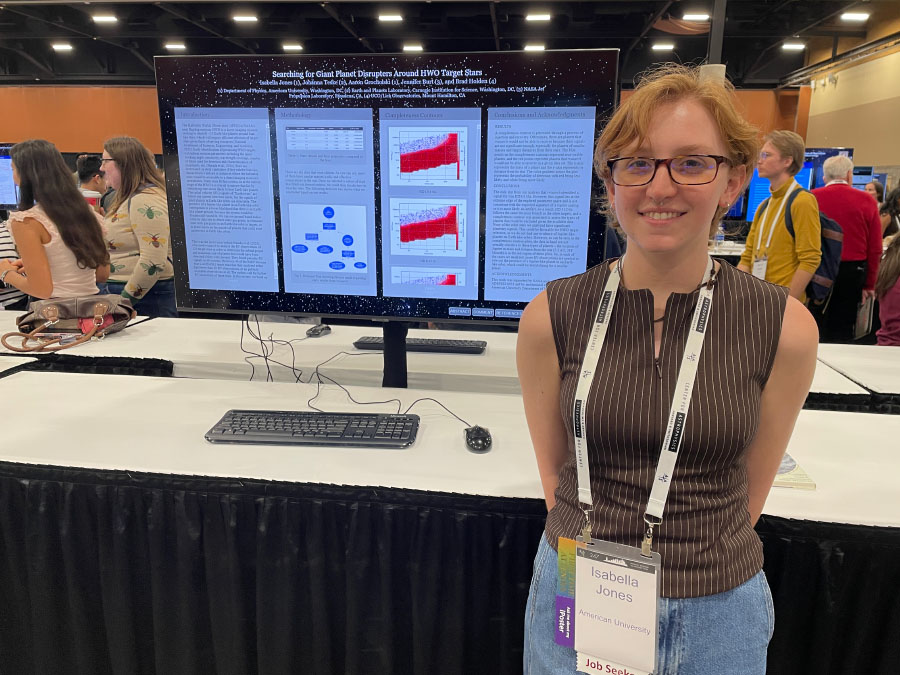
Isabella Jones (BS physics ’26) presented a poster on identifying promising stellar systems to observe with NASA’s upcoming Habitable Worlds Observatory. Her research helps narrow the list of potential targets for studying Earth-like planets beyond our solar system. Jones conducted the work with AU physics alumnus Johanna Teske at Carnegie Earth and Planets Laboratory, with guidance from Professor Aaron Grocholski.
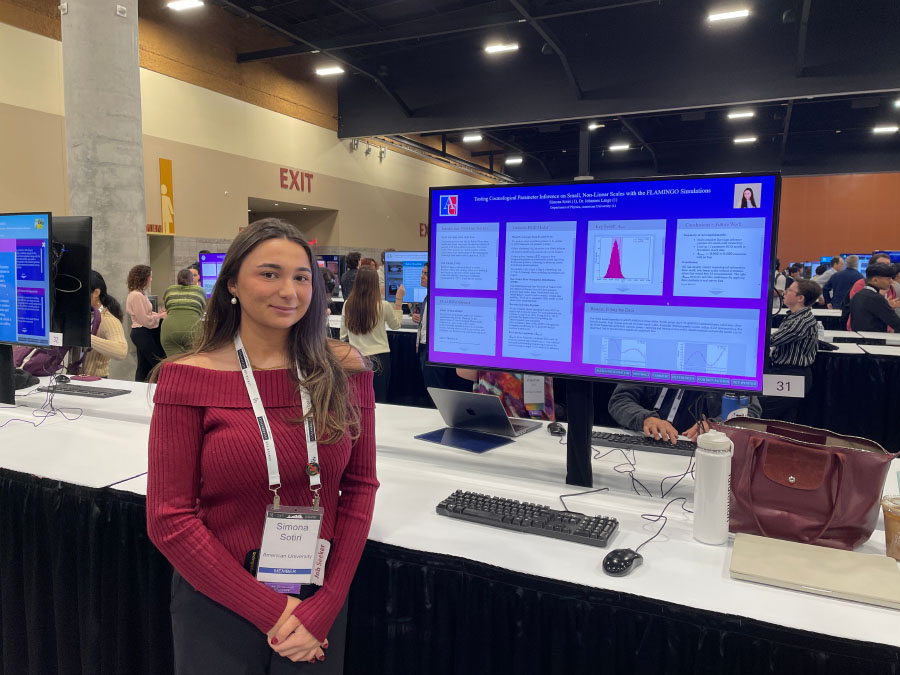
Simona Sotiri (BS physics and computer science ’26) presented research using one of the largest computer simulations of the universe, FLAMINGO, to test whether scientists can accurately infer the properties of dark energy from measurements of galaxies. Her work relies on large-scale data analysis and AU’s Lovelace high-performance computing system.
A Piece of Cosmic History
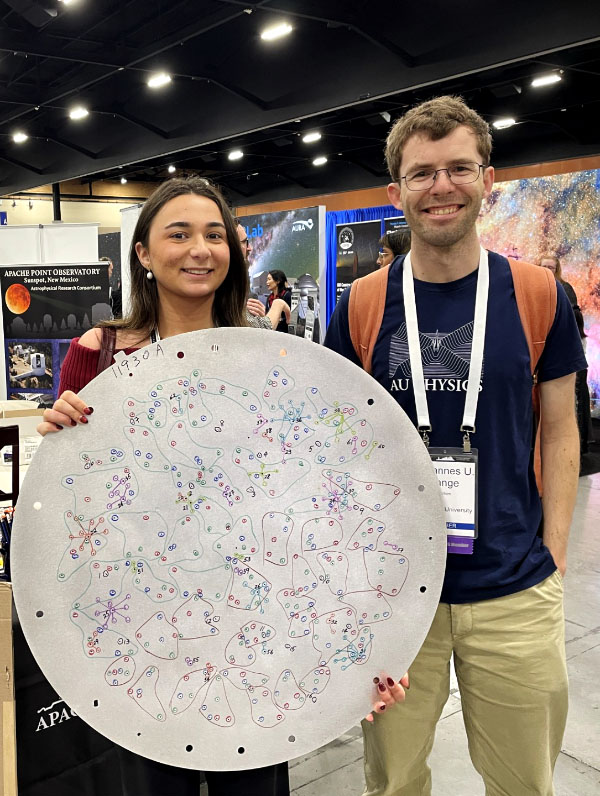
In addition to presenting research, Sotiri also came home with an unusual keepsake from the meeting. She received a Sloan Digital Sky Survey (SDSS) plate through a conference raffle—a large metal disk used to map the universe.
Each plate is drilled with hundreds of precisely positioned holes, designed to capture the light of distant stars and galaxies. When mounted on a telescope, a single plate can collect data from up to 1,000 celestial objects at once, helping astronomers map vast regions of the universe. These plates were central to the Sloan Digital Sky Survey, one of the largest and most influential astronomical surveys of the past several decades.
Sotiri has donated the plate to the Department of Physics, where it now serves as both a teaching tool and a tangible symbol of AU undergraduates’ direct connection to cutting-edge astronomical research.
Learning to Tell the Story of Science
For all five students, the conference was an opportunity to conduct research, and also to learn how to communicate it. To prepare, says Lange, “they worked closely with their mentors and also presented their research at the AU Physics capstone colloquia.”
Fisher credits this process, along with Lange’s mentorship, with helping her grow as a researcher: “He has helped me develop skills not only in analysis and computation, but also public speaking, confidence, and understanding my contributions and place in the field,” she says.