
Sarai Johnson’s Novel “Grown Women” Published to Literary Acclaim
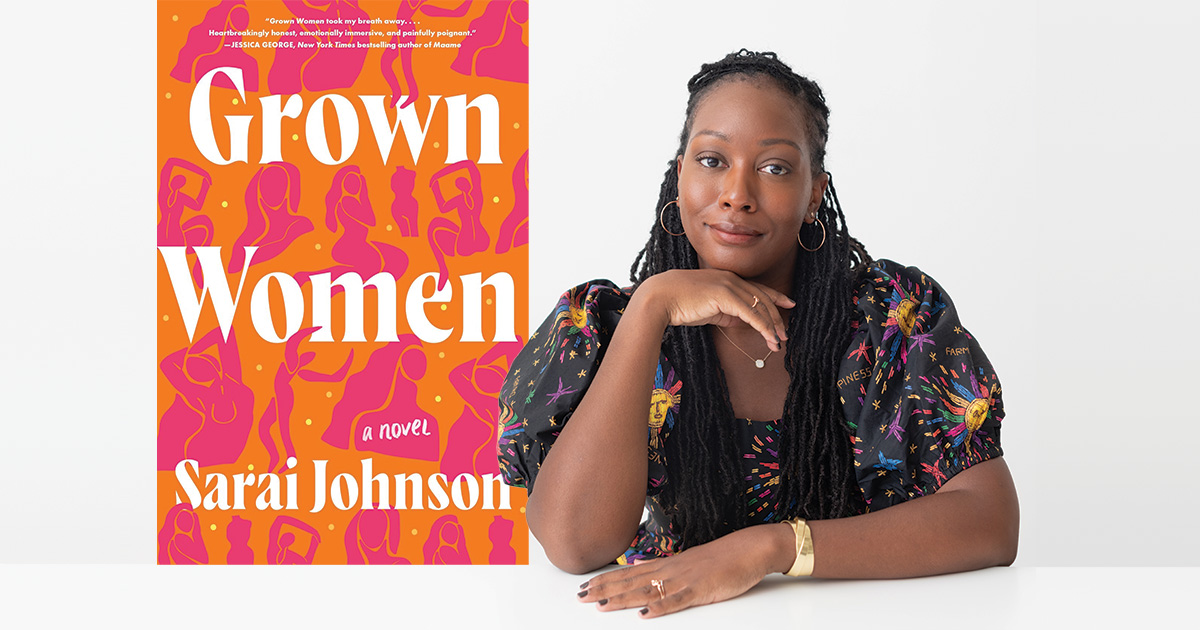 Sarai Johnson, courtesy of Laura Metzler Photography
Erudite Evelyn, her cynical daughter Charlotte, and Charlotte’s optimistic daughter Corinna see the world in strikingly different ways. Though their love for one another runs deep, their personalities—and the traumas they carry—often collide. Into this dynamic comes Camille, Corinna’s brilliant and resilient daughter, who brings with her a glimmer of hope and the possibility of reconciliation. Yet even with the best intentions, the women must learn to nurture a child while untangling the wounds and expectations passed down through generations.
This is the world of Grown Women, the debut novel by Sarai Johnson (MA Literature ’17). Its roots trace back to Johnson's time among the scholars and creative writers of American University's Department of Literature. The book has earned wide acclaim since its publication in 2024, most recently receiving the prestigious NAACP Image Award for Outstanding Literary Work and the Zora Award for Debut Fiction at the Hurston/Wright Foundation Legacy Awards.
Across the literary landscape, reviewers have praised Johnson for giving her characters vivid, authentic voices and for exploring generational trauma, forgiveness, and the enduring power of family. The LA Times calls Grown Women “a stirring debut novel [that] joins a lineage of epic family dramas that erupt with long-hidden secrets, devastating losses and ghosts.” A starred Publishers Weekly review describes the book as “a revelation, packed with stunning self-reflections and a deeply satisfying multigenerational saga,” while Elle hails it as “a tender, deeply perceptive tale of what kin owes kin, and how we might work to mend old wounds together.”
AU Helps Shape a Novelist
Johnson says her time at American University was instrumental in shaping both her craft and her confidence. “My confidence grew a lot in the program, because my professors gave me time, attention, and believed in me,” she says, crediting AU mentors including Erik Dussere, Keith Leonard, Stephanie Grant, Fiona Brideoake, David Pike, and Dolen Perkins-Valdez for guiding her development. “A lot of the work I did with Dolen [Perkins-Valdez] actually wound up in Grown Women,” she notes.
Johnson was always a reader and writer, but at American University, she learned to read books and look at stories in a new way. “I learned a lot about how stories function and how they’re put together,” she says. “I also realized that there was a story I hadn’t read yet that I really, really wanted to read, and AU gave me the confidence and support to pursue that.”
Fiction Writing Turns Personal
Johnson’s inspiration for Grown Women took shape long before the novel’s publication. Looking back, she realizes that she had been writing this story for years. “There was one character in particular that I wrote over and over,” she says. “She had different names, but she was always an alternate version of me. A bolder, more confident version of me. She turned out to be Camille, the youngest member of the family in Grown Women.”
Tracing Camille’s story led Johnson to a deeper question: where did this young woman’s courage come from? She soon realized its roots lay in the generations of women who shaped her. What began as an attempt to write Camille’s origin story widened into the stories of these women. As the stories unfolded, it became personal for Johnson; she found herself most drawn to the bonds among these women and to the questions they raised about what it means to be a mother or a daughter.
The writing process became an exploration of Johnson’s own life. “I was thinking about becoming a mother when I started writing,” she says. “I needed to figure out what to do about myself as a daughter so that I could be the mother I wanted to be.”
Writing Grown Women helped Johnson confront “a lot about myself and my goals as a mother.” Now, as she says, “I’m a mother of two. I’m making mistakes but hopefully doing things a little more mindfully than what came before.”
Research, Influence, and Craft
The writing process behind Grown Women was both meticulous and emotionally demanding. Johnson immersed herself in literature that could illuminate the lives of her characters—works like Toni Morrison’s Beloved and Sula, and memoirs such as Margo Jefferson’s Negroland and Natasha Trethewey’s Memorial Drive. She also had long conversations with relatives about her own upbringing.
The writing spanned six years, culminating in a novel that critics say captures the richness and complexity of intergenerational Black womanhood. “It was difficult emotionally, but I wanted each character to feel multidimensional and authentic,” Johnson explains. And while the story draws on personal experience, she emphasizes that fiction creates its own truth. “A lot of the book is based on real events, but I wouldn’t call it autobiographical. Writing fiction can be so much more revealing than actual facts.”
Even as she celebrates the success of Grown Women, Johnson is already contemplating her next project. After all, she has always been a writer, filling notebooks and diaries ever since she was a child. “I always write about something I’m trying to figure out for myself,” she explains, hinting that her next writing project will likely focus on friendship and marriage.
As Johnson looks back at her time at American University, she offers advice to the writers now sitting where she once sat. “Make sure you have people you trust with your work. Share it often. Create a writing group—it doesn’t have to be formal. Feedback and support are essential.”