
Pairing Passions: One Grad's Dance between Science and Stage
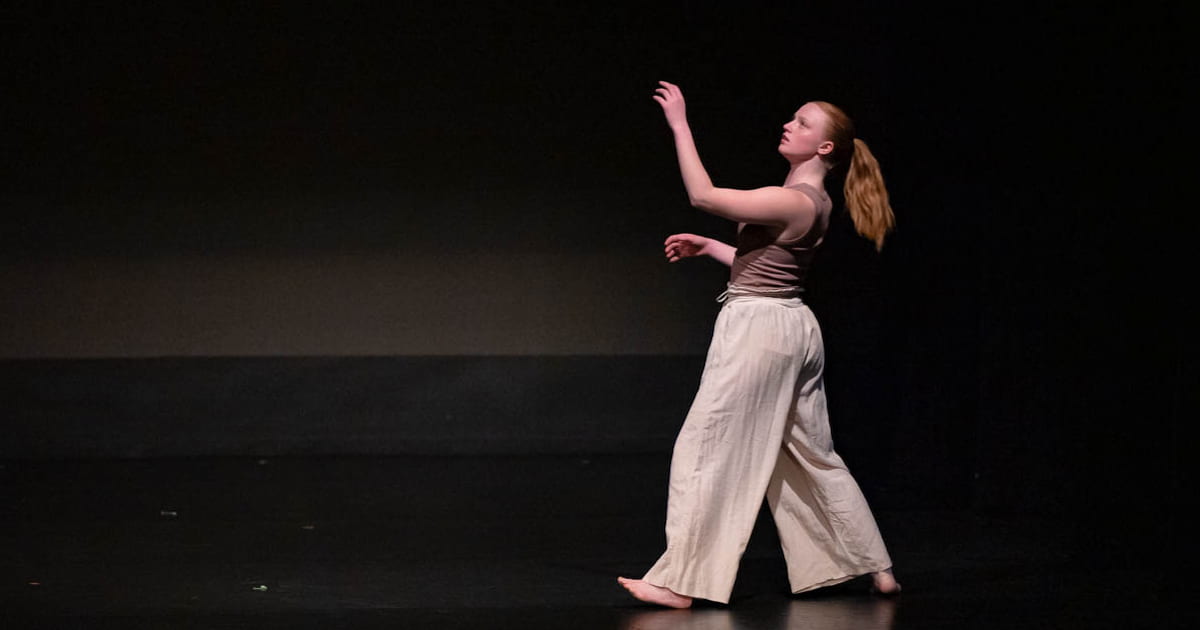
As a biochemistry major with a lifelong passion for dance, Ali Kirschbaum (CAS ‘26) spent her time at AU balancing demanding STEM courses with hours of dance rehearsals. She ultimately found a way to unite those worlds, using choreography as a means of communication to share her ornithology research with a broader audience.
Throughout her studies, Kirschbaum has been interested in scientific communication and how researchers can make complex ideas more accessible to the public. She sees dance as one way to build this connection, helping audiences engage emotionally with scientific research and the conservation challenges faced by these birds. “Dance is a beautiful way to connect people to birds and help them understand why our research is vital for their survival,” she says.
As a freshman, Kirschbaum attended a dance conference where she watched a dancer present her scientific research on erosion through choreographed movement. The experience sparked an idea: what if she could use dance to communicate her research on birds and tracking systems?
Signals in Motion
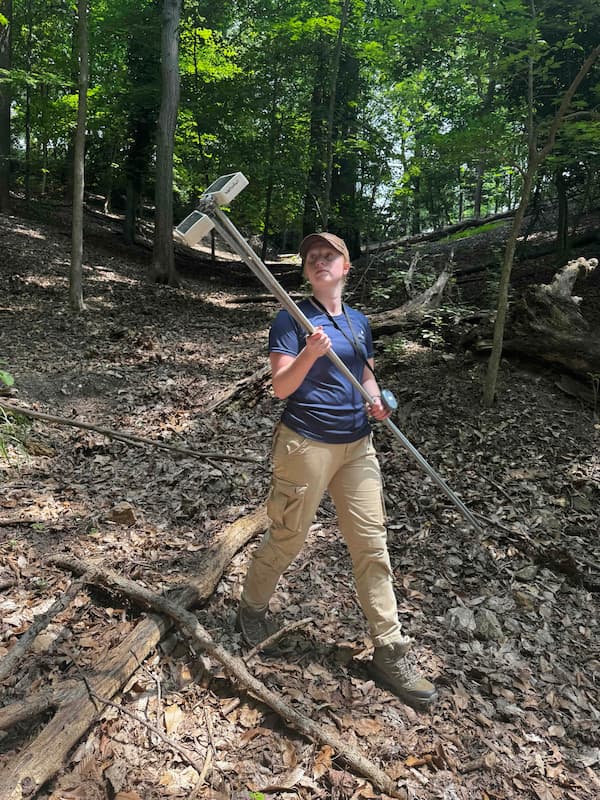
Last year, Kirschbaum scored an internship at the Smithsonian’s Bird Migration Research Center, which she called “the dream of a lifetime.” With support from the AU and NASA DC Space Grant Consortium and a CAS Summer Undergraduate Fellowship in the Arts, Humanities, and Sciences, she continued her research over the summer and completed a project titled “Signals in Motion: Growing Season Effects on Signal Attenuation in Automated Radio Telemetry Systems.”
Her research comes at a critical time. Bird populations in North America have declined by 29 percent, or 3 billion, since 1970. Wildlife tracking of birds can help researchers make conservation decisions. Tracking works by attaching a transmitter tag to a bird that sends a signal, and nodes placed at strategic locations will pick up on the signal. Based on how strong or weak the signal is, researchers can estimate the bird’s location. This is called Automated Radio Telemetry Systems, or ARTS.
Kirschbaum’s research was geared towards examining how changing seasons affect these radio signals, as denser vegetation can impact how well the signal is received and the bird’s behavior. Through testing in different seasons and in a variety of habitats, Kirschbaum calculated attenuation curves that reflect this gradual loss of signal strength. This information can help scientists understand these variables and more accurately place nodes.
Science to Studio
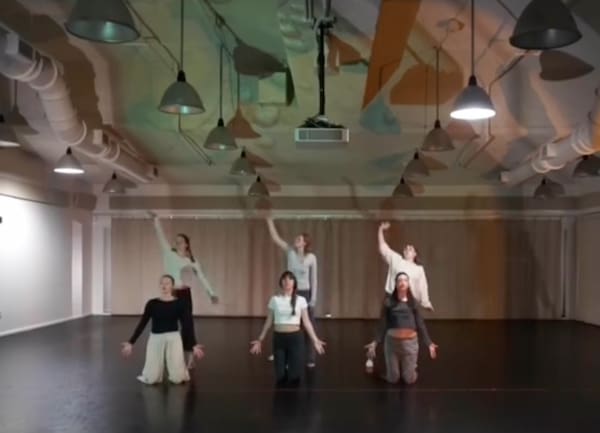
With faculty support, Kirschbaum decided to translate her ARTS research, populated with formulas and scientific terminology, into something that audiences may be more equipped to understand and connect with. Kirschbaum began the choreography process by creating a collection of art images that visually reflected her research. “I picked out nature imagery, especially those with rippling or spiral effects to mirror radio signals,” she says. She then brought the other dancers—who all happened to be STEM students—into the creative process and asked them to respond to the artwork, making the performance a collaborative effort.
The result was a four-minute-long dance performed by six dancers and set to Kirschbaum’s narration about her research layered with birdsong. The piece translated scientific ideas into movement through fluid choreography that, at times, brought the dancers together in radiating formations, and at others, pulled them apart. “The movements respond to the art inspiration and acted as a visual representation for the research,” said Kirschbaum.
Following her internship, Kirschbaum presented her choreographed dance at AU's Summer Undergraduate and Graduate Experience in Research (SUGER)—a partnership with the NASA DC Space Grant Consortium—and later at the Mathias Conference.
Leaving the Nest
Going forward, Kirschbaum plans to pursue graduate studies while continuing her bird research in laboratories with a focus on conservation. Drawing on her experience in dance, she hopes to continue working to make research more accessible and resonant for broader audiences. “Dance really is a universal language and can help scientists collaborate with others and share scientific research in an engaging and accessible way to the community,” says Kirschbaum.
See the research presentation and performance video, featuring Kirschbaum, Ana Martino, Olivia DeNaro, Anna Roat, Maddie Mester, and Elizabeth Riekse.