
Nicholas Boggs (MFA ’09) Publishes Landmark James Baldwin Biography
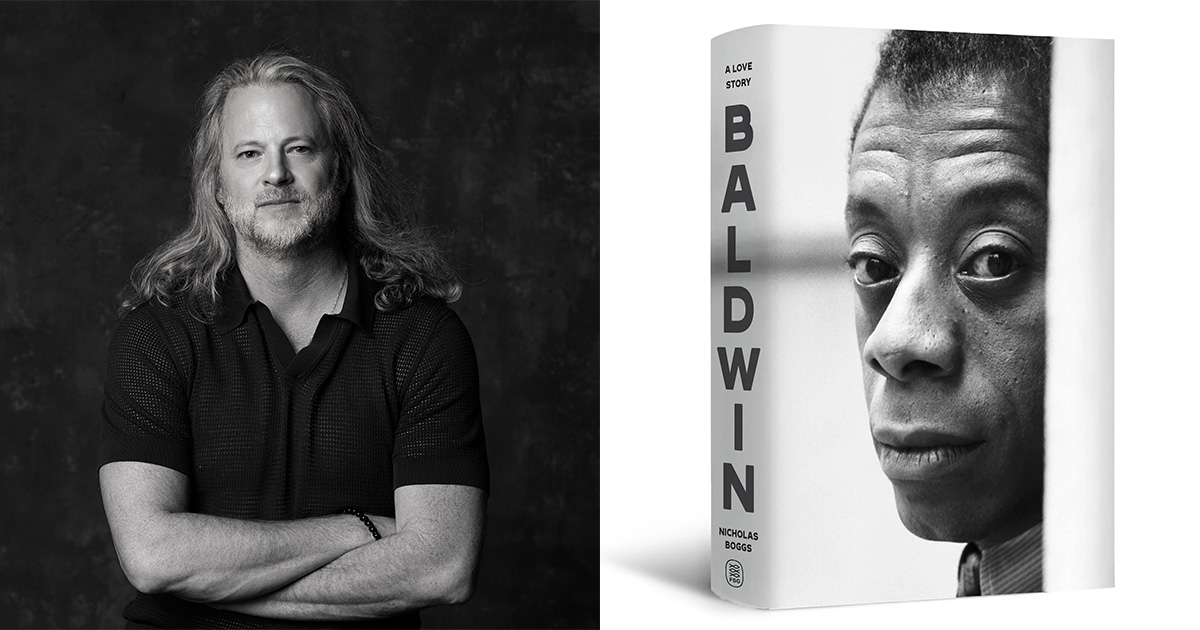 Photo by Noah Loof
When Baldwin: A Love Story was published by Farrar, Straus and Giroux in August, it instantly became a New York Times bestseller and one of the year’s most acclaimed works of literary biography. Written by Nicholas Boggs, a 2009 American University MFA Creative Writing alumnus, the 720-page work is the first major biography of American writer and civil rights activist James Baldwin in three decades. Drawing on newly uncovered letters, archives, and interviews, Boggs traces Baldwin’s writing through the intimate relationships that shaped his life. The book reveals how love—in all its forms and complexity—shaped Baldwin’s writing, politics, and activism.
Reviewers have called the book “a stunning achievement” (The New York Times), “the new gold standard for Baldwin studies” (Los Angeles Times), and “magnificent” (The New Yorker). It was named a finalist for the 2025 Kirkus Prize. Boggs is a recipient of the Whiting Creative Nonfiction Grant, NEH and National Humanities Center fellowships, and residencies at Yaddo and MacDowell.
In our conversation, Boggs reflects on the long creative journey behind Baldwin: A Love Story, the lessons he learned at AU, and why love is the key to understanding Baldwin.
PH: Writing Baldwin: A Love Story meant living with Baldwin’s life and work for years. When you set out, did you know what the book would become, or did its shape and scope emerge as your research deepened?
NB: I definitely did not know what the book would become when I set out, because that was over twenty years ago. I had discovered Baldwin's out-of-print children's book, Little Man, Little Man, as an undergraduate and then in the early 2000s I found out that the book's illustrator, French artist Yoran Cazac—whom I had been told from a reputable source was deceased—was actually alive. It turned out he was Baldwin's last great love, and I’m the only biographer who had the chance to interview him in person before he died in 2005.
PH: You’ve written that love was your guiding lens for understanding Baldwin. Why did love feel like the truest key to his story, and what did that lens open up for you as a writer?
NB: I write at the end of my author's note in my book that it took me years to realize that what I was researching and trying to write for decades was a new Baldwin biography, but from the very beginning I always knew it was a love story.
But as my research expanded, I realized that Baldwin's entire life and work was a love story. All of his novels are love stories, and love is at the core of his political writing. The Fire Next Time, for example, is all about how black and white Americans must come together like lovers, he writes, in order to truly see each other and relate to each other, and, in his words, "make freedom real." And now, of course, his legacy has become a love story, because so many readers and people love not just his work but who he was as a person, and what he represents: some measure of hope in very hateful times.
PH: In Baldwin: A Love Story, you show how Baldwin’s closest relationships shaped his writing and identity. What did spending years inside those connections teach you about how love and creativity inform each other?
NB: They are inseparable. Baldwin wrote from a place of love—he dedicated his books to the painter Beauford Delaney—his "spiritual father;"; to his greatest love, Lucien Happersberger; to the Turkish actor Engin Cezzar, his collaborator and "blood brother," as he called him; and finally to Cazac. He loved his family and also Mary Painter, his best friend in Paris, to whom he dedicated Another Country. In fact, in his voluminous letters to Painter, it becomes very clear how intertwined his creative process was with the push and pull of his romantic entanglements and how connected it all was in his journey towards self-love.
He grew up being told he was ugly, a sissy, which led him to see love as a battle, a war, a growing up, as he put it. And he used these insights—this hard-won self-love—to reflect on what it means to try to live up to the democratic ideals of the country of his birth, a country that he loved but with a love that, in its own way, was very difficult for him to keep believing in, and striving for, and yet somehow he did, even if it meant spending most of his life abroad.
PH: You once sat where AU’s writing students sit now—drafting, revising, wondering what might last. What would you tell today’s emerging writers about having faith in their work, especially when they are working on a book or other project that takes a long period of time to complete?
NB: Baldwin wrote that talent is insignificant, that he knew a lot of "talented ruins." He might have been exaggerating a bit (talent does matter, I think) but what matters even more is perseverance, hard work, and love. And that's really true when it comes to being and becoming a writer. So I would say that sticking with it and loving what you do, these are the most important attributes to becoming a writer.
PH: Looking back to your time in AU’s MFA program, are there moments, mentors, or lessons that still echo in your work today—especially through the long journey of researching and writing Baldwin: A Love Story?
NB: I completed my PhD at Columbia in 2005, and in my mid-thirties I moved back to DC, my hometown (I grew up just a few blocks away from AU and went to elementary school at Horace Mann), for my MFA. It was an unusual chronology (most people who do both an MFA and PhD do it in that order). So I was pretty old for an MFA student. But it was one of the best things that ever happened to me. I was finally ready to become a writer.
And, in fact, it was in that MFA program that I wrote the first paragraphs of this book, because I was there to work on both creative nonfiction and fiction. Specifically, I began working on the section when I was tracking down Yoran Cazac and emerged as a kind of character myself. Pulling that off really required the kind of excellent teaching and guidance I received at AU from teachers like Richard McCann, Andrew Holleran, and EJ Levy.
And now I am returning to the novella that I wrote as my MFA thesis at AU, so many years ago, to help shape my next book, which mixes fiction and memoir. Much like my Baldwin biography, it's a project that has had to germinate for years and changed directions several times. That's just how I work, how I write, and I'm so grateful that AU provided me the space and springboard for these two books. I often tell people how much the late and great Richard McCann changed my life, and it's true. (I've written about that, here in the Lambda Literary Review.)
PH: If Baldwin could read A Love Story, what do you hope he’d recognize in your portrait of him?
NB: I hope he'd recognize it as more than a portrait of himself, but rather, as a portrait of himself in relation to those he loved and who loved him, and how they mutually sustained and transformed each other. He had a large table at his home in the south of France that he called "The Welcome Table," and the play he was working on when he died had that as its title. It was where his friends and loved ones would gather for food and drink and talk and laughter. Everyone from his lovers to Nina Simone, Toni Morrison, Marlon Brando, Miles Davis, the list goes on and on. Sometimes Baldwin's life is thought of as a tragedy, or all-suffering, but I try to show that it was also full of love and communion and fellowship with his chosen family. I hope he would recognize this truth in my portrayal of him and those he loved. I hope he'd feel the love.