
Joanne Allen’s Art Brings Istanbul to Life in New Katzen Exhibition
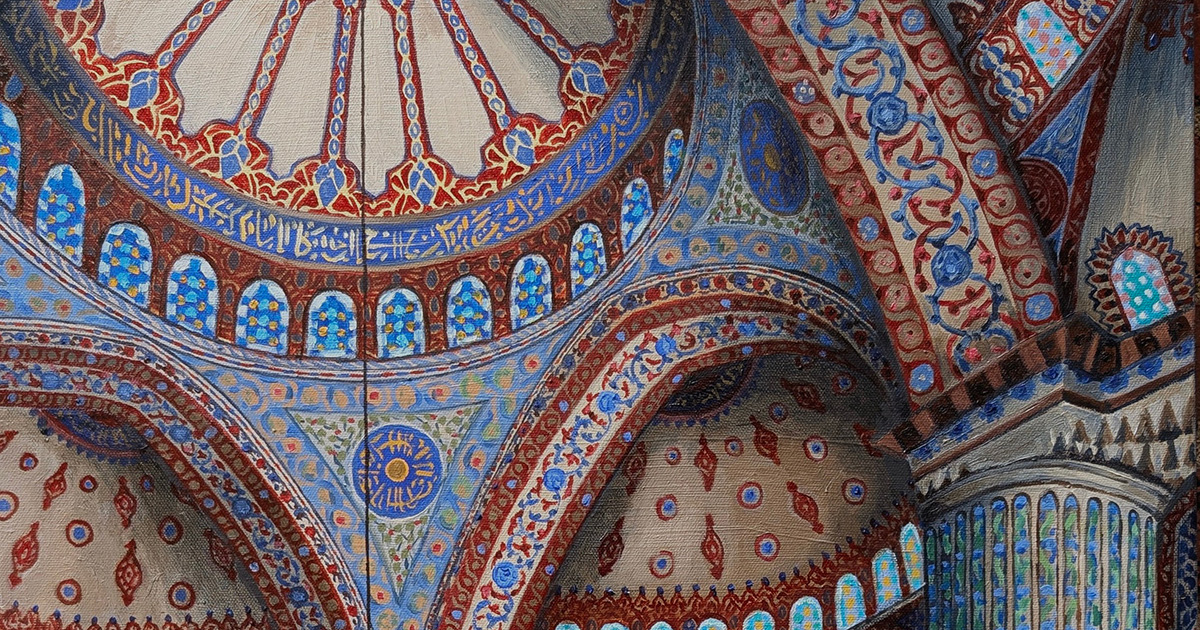 The Blue Mosque (Sultan Amet I Camii), oil on canvas, 2025, Joanne Allen
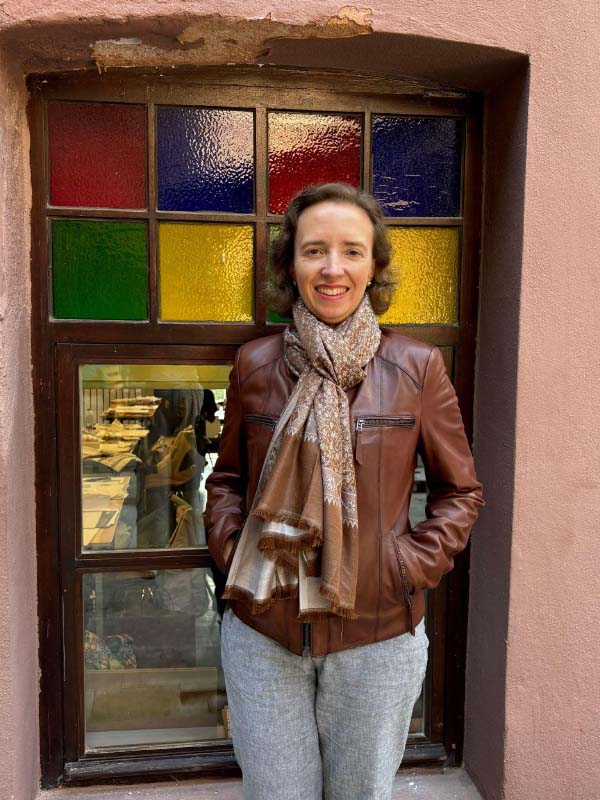
Joanne Allen, Hurst Senior Professorial Lecturer in Art History, is best known to her students as an art historian who focuses her scholarship on Medieval and Renaissance art. But she is also an accomplished artist. Her latest exhibition, Constantinople/Istanbul: Art and Religion between East and West, features drawings, paintings, prints, and fabrics that capture Istanbul’s artistic marvels such as the Chora Church mosaics, the Hagia Sophia's intricate capitals, the Blue Mosque, and Ottoman-era tiles and carvings.
The exhibition is on view in the Katzen Arts Center Rotunda through February 8.
In Constantinople/Istanbul, Allen explores not only the visual beauty of the city but also its rich historical and cultural significance at the crossroads of civilizations. “Istanbul has such a long and important history,” she says. “Emperor Constantine moved the capital of the Roman Empire there, naming it New Rome, although it soon took the name Constantinople. The city sits on the Bosphorus, the narrow strait between Europe and Asia—then, as now, a crucial point for world trade. Over the centuries, Romans, Byzantines, and Ottomans all made it their capital, showing how central the city has been to art, religion, and culture.”
Patterns, Light, and Detail
In Constantinople/Istanbul: Art and Religion between East and West, Allen captures the scale and light of Istanbul’s dramatic interiors through her chosen media, each allowing her to emphasize distinct aspects of her subjects. “Printmaking is achieved through layers, so the color range is limited––this worked well for the exterior of the Chora Church, which only shows two colors,” she explains. “However, for the moody interior of the Blue Mosque, I chose oil paint so that I could use glazes to capture the dark shadows.”
For Allen, the architectural details are equally important, and her artworks carefully document these details. “I am particularly drawn to repetitive patterns because through drawing them I want to understand how they are constructed, she says. “Even when I look at a figure of a saint in the Chora Church, it’s really his geometric patterned vestment that I’m most interested in.”
Sometimes, the act of creating art teaches Allen as much as—or even more than—the scholarly research itself. “Doing a painting or drawing of a work of art or architecture forces you to slow down and look extremely carefully at both the details and the construction. It is one thing to research art from a scholarly perspective, but drawing it requires a closer visual engagement that often yields a deeper understanding,” she says.
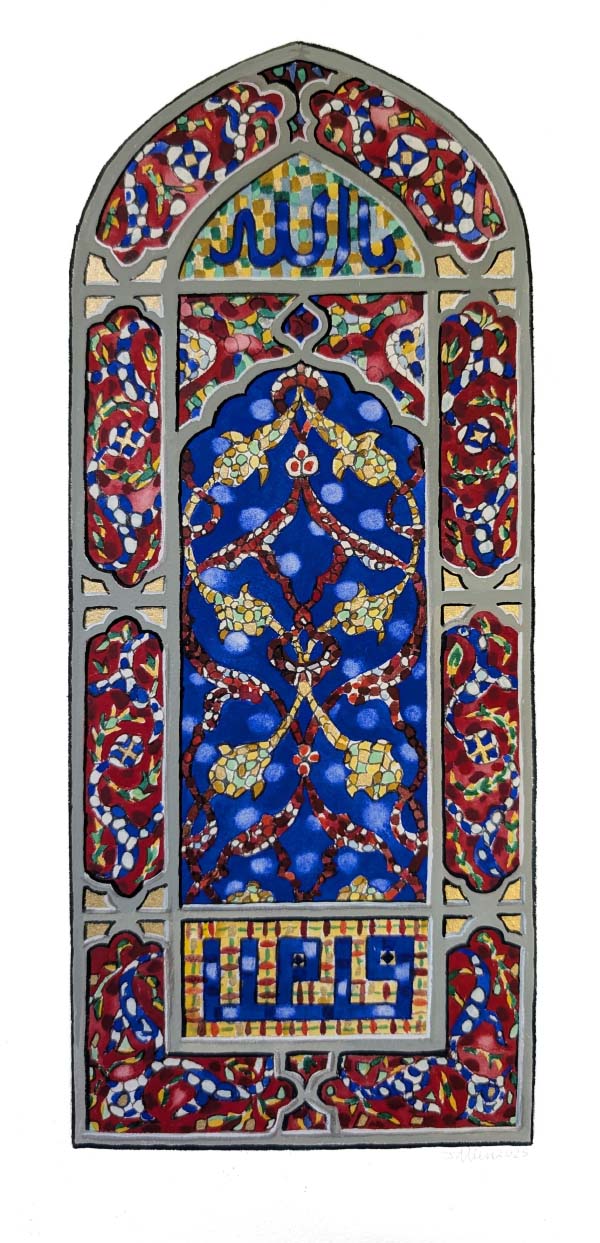
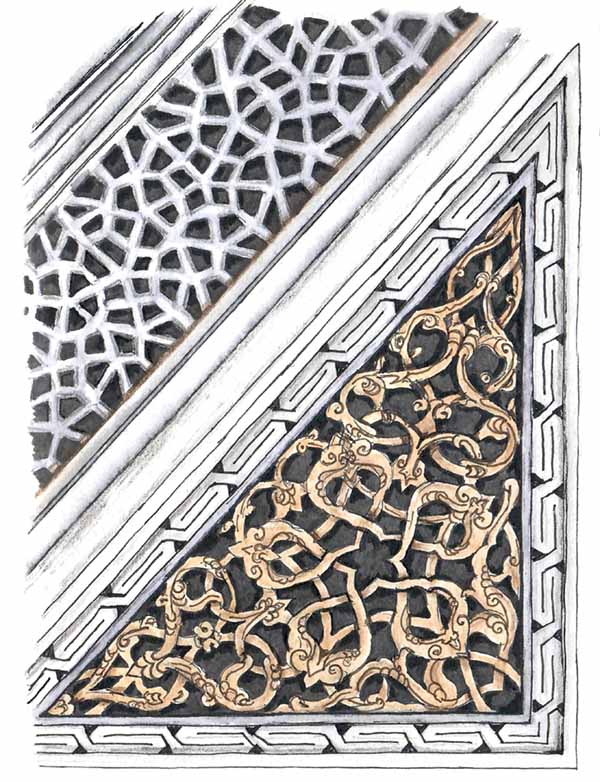
“For example, through producing a watercolor painting of a stained-glass window from the Suleymaniye Mosque, I feel that I truly understand how the window was constructed––windows in mosques were made of two layers, inside and outside––the complex interior pattern was outlined by stucco, and a different pattern of circles appears on the outside. Likewise, some of the geometry might at first glance seem effortless, but when you try to reproduce it, you realize just how sophisticated it is. For example, I drew a minbar carving that had a five-pointed design within a triangular framing that was extremely difficult to work out.”
Allen hopes that viewers take away some understanding of Istanbul’s history and how it changed hands multiple times. “I hope they recognize the interconnectedness of cultures and religions through the artwork,” she says.
Constantinople/Istanbul: Art and Religion between East and West is supported by the Carmel Institute, with travel for the project funded by AU Mellon funds. The exhibition is free and open to the public.
For more info, visit Katzen Arts Center Exhibitions.