
Five Novels. Seven Weeks. One Beloved “Beach Reads” Class.
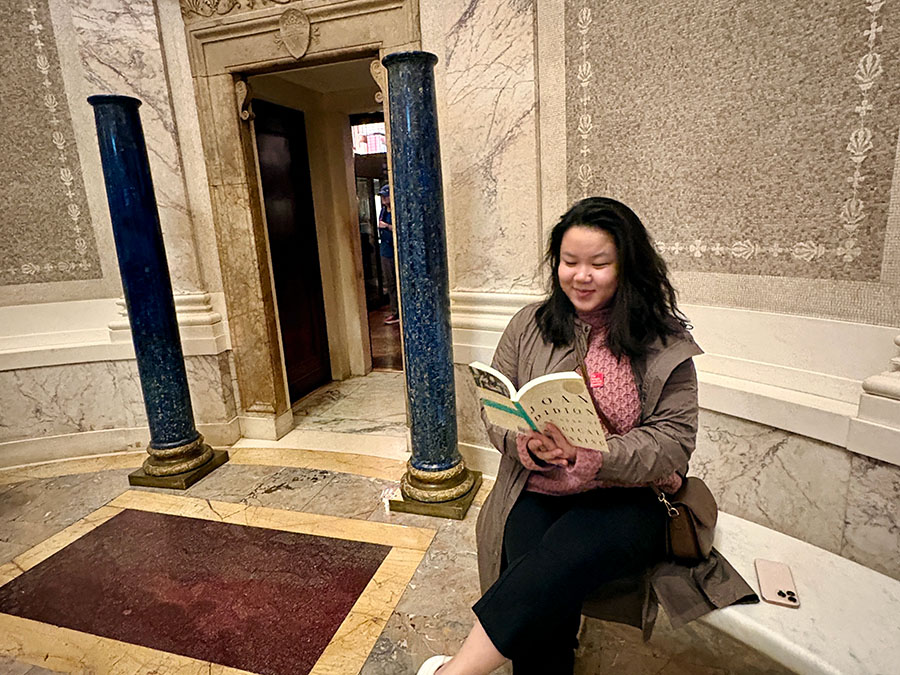
Melissa Wood at New York’s Morgan Library and Museum
Summer has arrived, and with it a familiar reading debate: what, exactly, makes a beach read?
For Literature Professor Marianne Noble, a beach read is “compulsively readable—a real page-turner, a book you can’t put down. It is also profound and fascinating, and potentially life changing.”
That idea—that books can be both entertaining and transformative—is the premise behind Noble’s popular summer course, LIT-121 Rethinking Literature: Beach Reads.
At a moment when so much of our information and entertainment arrives via screens, texts, and feeds, Noble believes that literature offers something increasingly rare. “The thing about literature is that it is an opportunity for sustained thinking about a subject in a way that is enjoyable,” she says. “It is very different from the soundbite forms of information accessible on social media.”
The course is part of AU’s Habits of Mind curriculum, and it reflects the program’s emphasis on curiosity, critical inquiry, and discussion-driven learning. Noble’s premise is simple: books that are deeply enjoyable can also challenge students to think more carefully about themselves and the world around them.
Getting Back to Reading
Over seven fast-paced weeks, the syllabus includes literary heavyweights and contemporary classics alike, from Margaret Atwood’s The Handmaid’s Tale and Octavia Butler’s Parable of the Sower to Anthony Doerr’s All the Light We Cannot See, Louise Erdrich’s The Round House, and Richard Powers’s The Overstory.
Noble says the course is also responding to something she hears repeatedly from students: “They say that they used to love reading, but they have not had the opportunity to read very much lately,” Noble says. “All of them wanted to get back to reading and were excited to do so.”
This sentiment resonates with rising junior Colin Szustakowski, a political science major who enrolled in the course partly to rebuild his reading habits that too often get crowded out by classwork and daily life. “My favorite part of the class is that it makes sure I am regularly reading fiction,” he says. “I enjoy leisure reading, but I lose the chance to do it during the school year or whenever life gets busy.”
The structure of the course, he says, has had a surprising spillover effect. “I've been more dutiful with my own fiction reading outside of the class curriculum,” he says. “It's a good problem to have.”
Books Worth Adoring
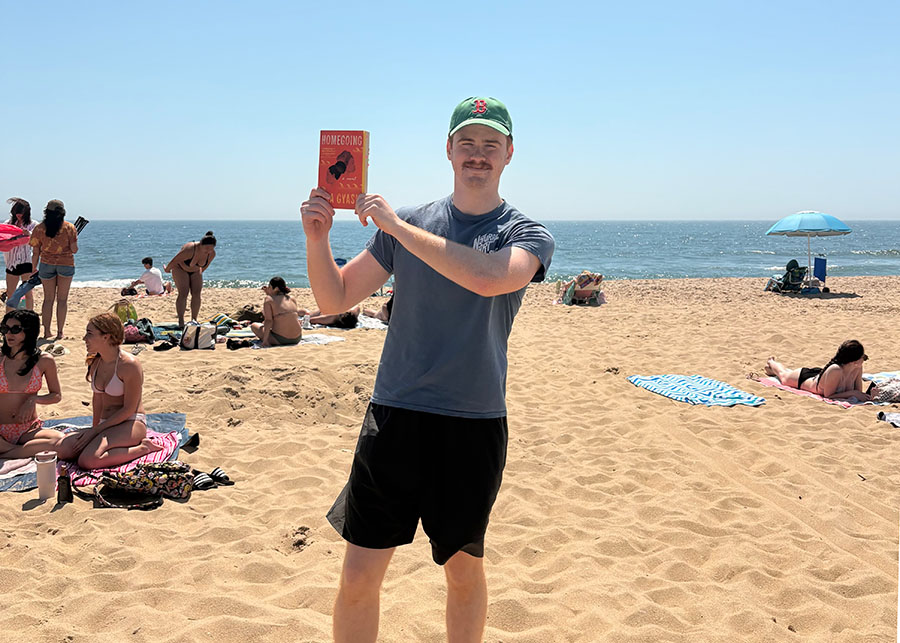
Colin Szustakowski on the beach with Yaa Gyasi’s Homegoing
Noble says she chose books that students would not only enjoy but also find transformative “Everybody enjoys them! They are crowd pleasers.” she says. “They are also high-quality fiction.”
That combination is part of what appeals to Melissa Wood (BA psychology, summer ’26). This week she is reading A Gentleman in Moscow. “I picked this book because to me it’s the epitome of beach reads,” she says. “Fun and gentle while at the same time thought provoking regarding history and the aftermath of the Bolshevik Revolution––and more broadly about how we as humans adapt to our circumstances.”
The books vary widely, but Noble says they share one essential quality: they pull readers completely inside other people’s lives and ways of seeing the world. “Literature explores ideas from different angles,” she says. “It picks things up and looks at them from multiple perspectives. It also immerses us in the feeling of a situation.”
She points to Yaa Gyasi’s Homegoing as just one example. The novel places readers emotionally inside the lives of people in West Africa awaiting forced transport to America. “We enter into that situation, imagining ourselves inside of it,” Noble says. “This changes us. It opens our mind and broadens our perspective.”
For Noble, fiction’s power also comes from the active role readers play in creating meaning. “Books are like blueprints, not movies,” she says. “They describe a room in words, and we create it in our own imaginations.” Unlike more passive forms of entertainment, literature asks readers to participate—to interpret, imagine, and question. “Literature respects us,” Noble says. “It does not dictate to us. It does not tell us the answers.”
Slower, Deeper, More Profound
Each week, students post discussion questions, write essays, attend virtual lectures, and meet individually with Noble to review feedback and refine their thinking. The format emphasizes close reading, interpretation, and intellectual risk-taking, echoing AU’s broader focus on discussion-driven learning, mentorship, and curiosity as habits that extend beyond the classroom.
For Szustakowski, the class has rekindled something many students lose amid classes, jobs, and busy schedules: the simple pleasure of reading a great book and talking about it with other people. “I’m glad it’s making me read, and it’s pairing me with people to talk to about it,” he says. Noble’s book-club approach to the class, he adds, creates an atmosphere where discussion comes naturally.
The impact extends beyond the weekly assignments. “The more I read, the more I am driven to write,” Szustakowski says. Reading fiction, he adds, makes him “more mindful and observant” and enriches the way he experiences everyday life.
Those kinds of experiences are exactly what Noble hopes students take away from the course—more than simply having finished a stack of books. “When we read high-quality fiction, we feel a profound fulfillment that’s very different from the light pleasure of scrolling on a phone or watching a sitcom. It is slower and deeper. And it is also infinitely more profound.”