
Thirteen Students. Five Years. One Remarkable Scientific Discovery.
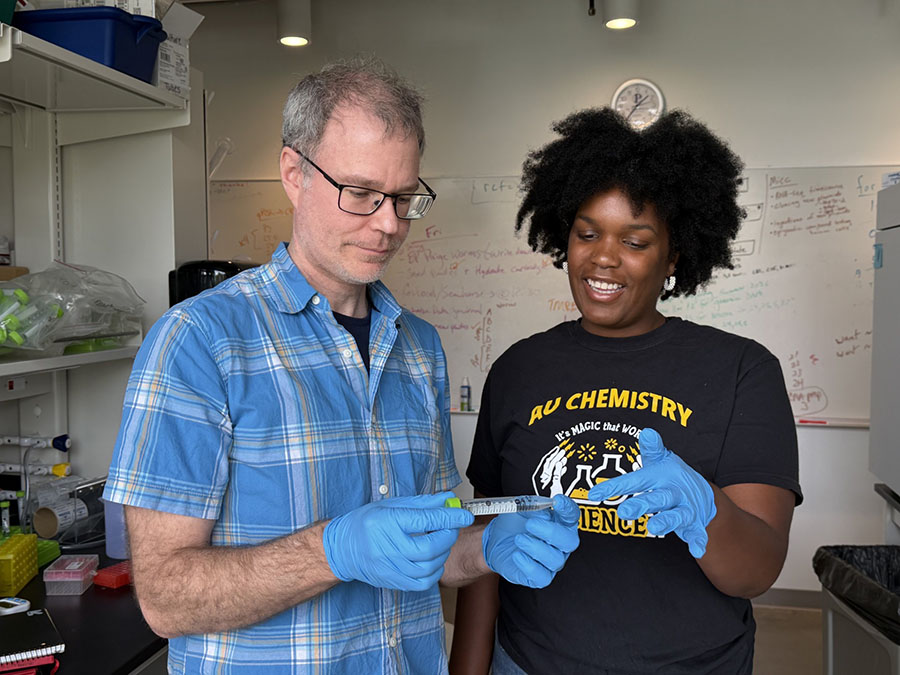
Professor John Bracht and Bianca Brown in the laboratory.
When Bianca Brown arrived at American University as a post-baccalaureate student, she was pursuing her longtime dream of becoming a physician. To gain research experience, the former middle school science teacher joined Biology Professor John Bracht's laboratory.
Over five years in the Bracht Lab, Brown and fellow student researchers successfully produced the first successful zebra finch germline organoids—tiny three-dimensional clusters of cells that mimic aspects of reproductive tissue development. The organoids give researchers a new way to study how reproductive cells survive, communicate, and develop over time.
The work also culminated in a paper published in Scientific Reports, with Brown as lead author alongside 12 fellow student co-authors—eight undergraduates, a post-baccalaureate student, and three graduate students.
Throughout the project, Brown and the other students contributed to every stage of the research. They maintained cell cultures, analyzed data, generated figures, drafted the manuscript, and helped drive the research forward.
“Without the students, there would not be a paper,” Bracht says.
For many of these students, the project shaped the trajectory of their careers. Elizabeth Nagy (BS biology '27), who joined the lab as a first-year student, still remembers the moment she realized she belonged in research. After days spent preparing organoid sections and conducting complex imaging, she finally had an opportunity to see the outcome of her work.
"When we were finally able to view the organoid sections under the microscope, they lit up perfectly," she said. "That was the first moment I felt like a true scientist."
From Honors Thesis to Discovery
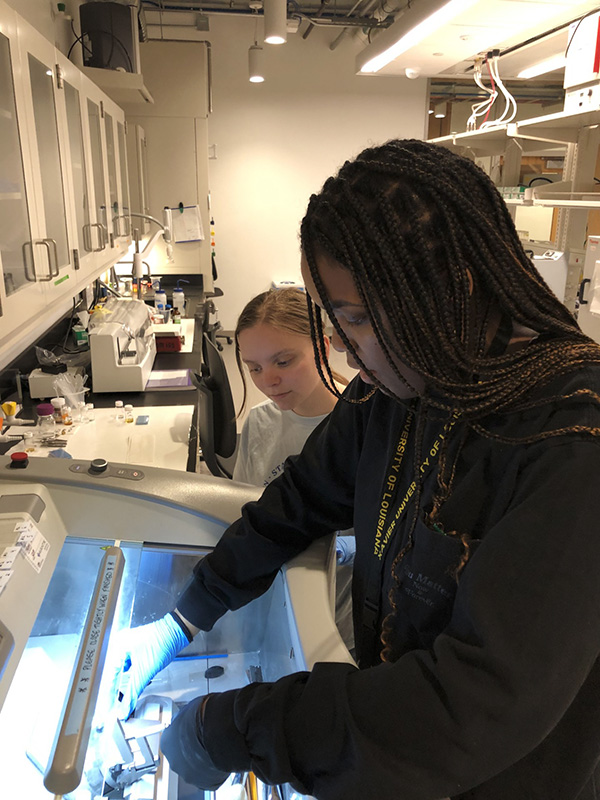
The research all began when Ajuni Takkar (BS biology/computer science '23) proposed studying germ-cell cultures for her honors thesis. She and a team of students spent months maintaining cell cultures and carefully monitoring how the cells behaved.
Then came an unexpected—and key—observation by Naomi Greengold (BA international/global studies '23), who noticed unusual structures forming in a culture dish.
When the students investigated further, they discovered that the cells were organizing themselves into organoids. Remarkably, the organoids contained primordial germ cells—the specialized reproductive cells that eventually become sperm or eggs.
That observation became the foundation for the project that would eventually result in the Scientific Reports publication.
As the work expanded, Brown––who has recently been accepted into the MA in Biomedical Sciences program at Virginia College of Osteopathic Medicine––emerged as one of its leaders, helping coordinate the day-to-day research while mentoring newer students joining the lab. She helped students maintain cell cultures, track organoid growth, analyze data, generated images, and train the next generation of researchers as older students graduated and moved on.
Writing the Paper
By 2024, the research team had spent years collecting data, documenting organoid growth, and refining experiments. The next challenge was turning that work into a scientific paper.
Rather than drafting the manuscript piece by piece over several months, Bracht tried something different. In November 2024, he gathered the student researchers in his lab for an all-day Saturday writing retreat with an ambitious goal: to produce the first draft in a single day.
Some students worked on the introduction. Others focused on the results section. Team members analyzed data, created figures, and organized images that had been collected over the course of the project. Bracht provided coffee, lunch, and lots of feedback.
"Our goal was to generate the first draft in a day," Bracht said. "I've never done a paper that way, but it was a blast. One hundred percent I would do it again."
The retreat became a turning point for the project. Although additional analyses, revisions, and figures would follow, students generated the foundation of the manuscript themselves.
Growing as Researchers
For Elizabeth Nagy (BS biology ’27), the project provided something she had never experienced before: the feeling that she truly belonged in a research lab.
She joined the project as a first-year student, helping maintain the organoid cultures by changing media once or twice a week. Over the next three years, her responsibilities grew to include microscopy work, data collection, laboratory research, and manuscript revisions.
The experience changed how she viewed her future. "Before doing research with Dr. Bracht, I wasn't sure if I wanted to do research as a career," she said. "To be honest, it wasn't even on my radar."
Today, she plans to pursue a career in research, an outcome she never imagined when she first joined the Bracht Lab.
Why It Matters
The team's research has the potential to help researchers better understand reproductive development in birds, improve conservation efforts for endangered species, and create new opportunities to study genetic inheritance and developmental biology.
But for Bracht, the project's impact extends beyond the science itself. "Lab research is transformative for students," he says. "Suddenly the things they learn in the classroom have meaning, a weight or a body that they don't otherwise.”
Opportunities like these are part of what Bracht calls "R1 the AU way," where students have opportunities to work directly alongside faculty and play meaningful roles in long-term scientific projects.
“Here at AU we truly enjoy the chance to mentor undergraduates and master’s students in the lab, and we think research is enhanced when we do this,” he says. "Students should get involved in research as early as possible. Students make science better, and they gain skills and expertise at the same time."