
Balancing Acts: Meet American University’s Dancer-Scholars
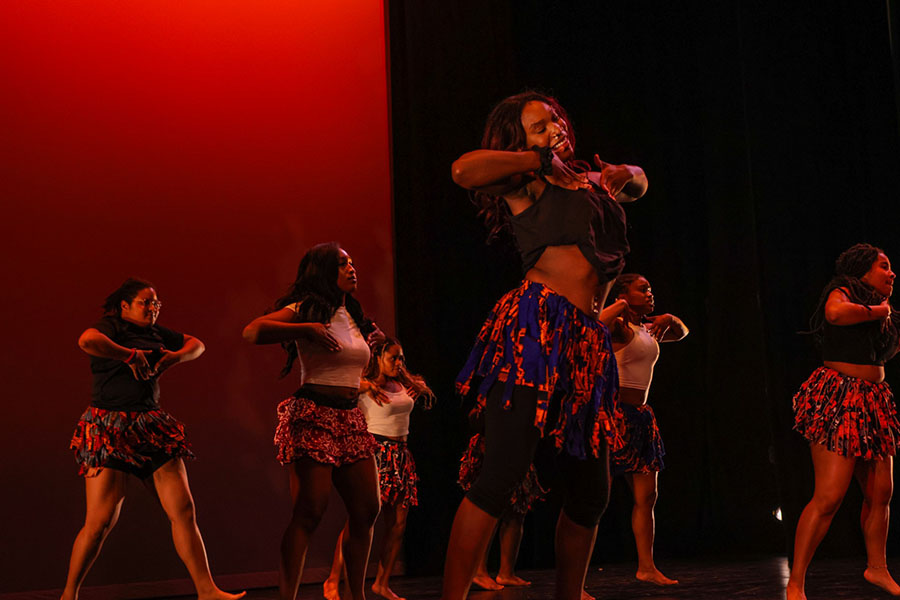
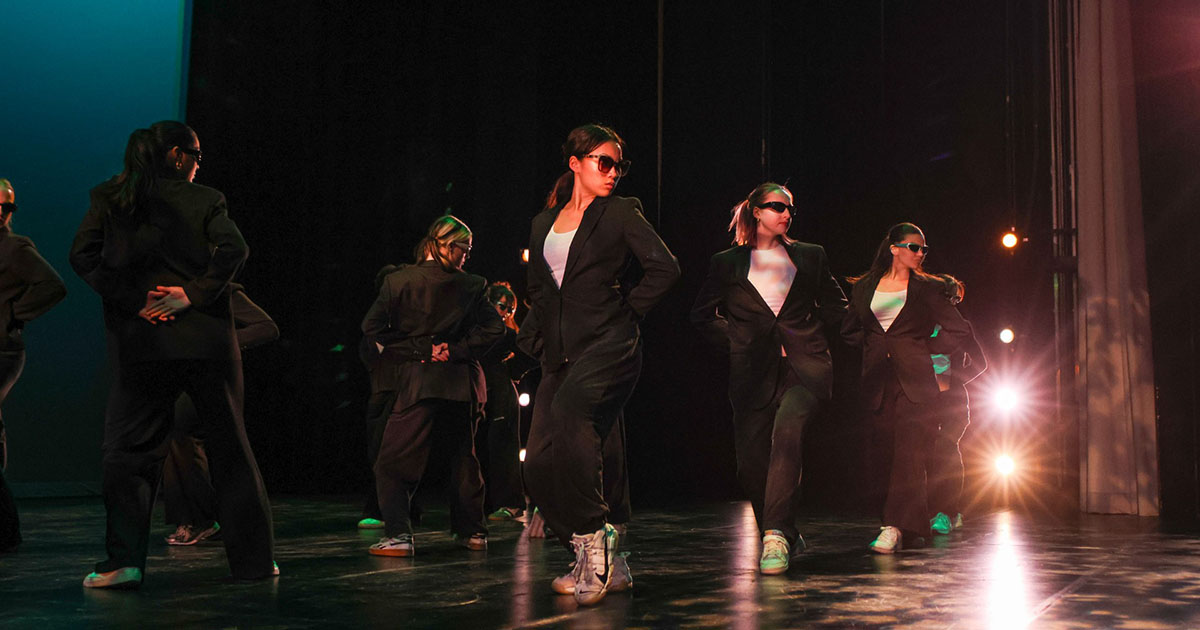 AU in Motion on stage, photo by Conny Galvez
Between dance rehearsals and laboratory research, American University students Anna Roat, Adela Camposano, Ali Kirschbaum, and Lia De la Rosa Adrian are navigating two demanding worlds—often in the same day. All four are pursuing STEM degrees while dancing with AU in Motion, a student performance club, where they rehearse and perform together in a tight-knit community.
Anna Roat (BA/MS environmental science ’27) studies Arctic marine food webs by day and co-creates dance pieces with her club friends by night. Adela Camposano (BA psychology ’26) credits competitive dance with sparking her curiosity about mental health, while Ali Kirschbaum (BS biochemistry ’26) and Lia De la Rosa Adrian (BS biochemistry ’28) both see striking parallels between the focus, precision, and creativity that are required in science and dance.
At AU, these students are choreographing lives that include serious studies and artistic expression.
Anna Roat (BA/MS environmental science ’27)
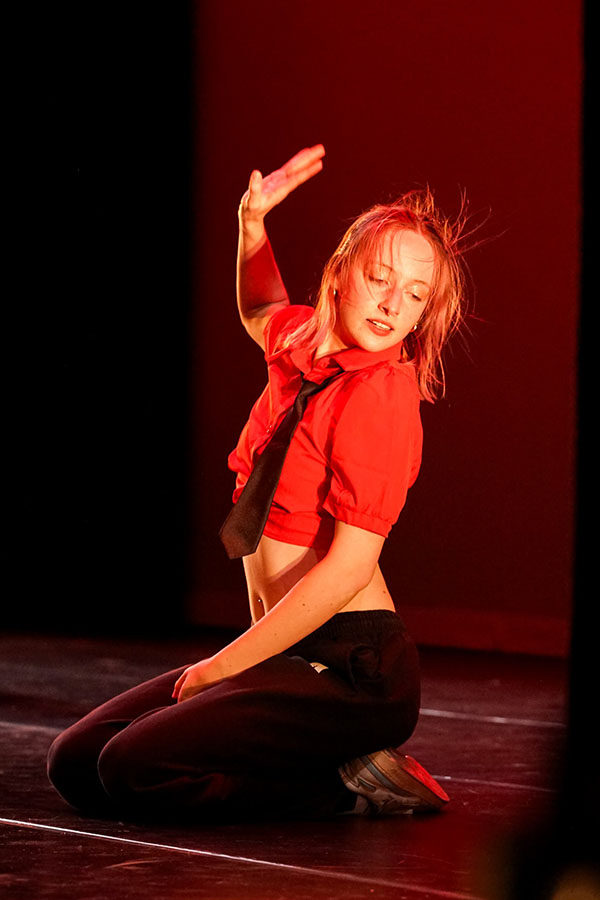
For Anna Roat, environmental science is rooted in a lifelong connection to the natural world. “I chose to study environmental science because I’ve always loved spending time in nature, and I want to help protect it,” she says.
That passion led her to AU’s Arctic Lab, directed by Professor Chelsea Koch, where she began working as an undergraduate to gain lab experience. She was drawn to Arctic marine food webs and to the central role Indigenous knowledge plays in Arctic research, particularly in the Pacific Arctic, where coastal communities’ cultures are deeply intertwined with the marine ecosystem. After graduation, she hopes to continue researching the Arctic marine environments that these communities depend on.
In the lab, Anna uses sea ice biomarkers to investigate the role of ice algae in snow crab diets and explore connections between sea ice loss and crab mortality in the Bering and Chukchi Seas. “Doing Arctic research and working with Dr. Koch, I know how important it is to form interdisciplinary connections and collaborate with other scientists and community members,” she says. “I’m excited to see where our collective research leads.”
Anna’s other community is her dance community. At eight years old, she attended a performance at a performing arts school and knew she wanted to dance. By age ten, she had auditioned into the program, and from grades six through twelve, she trained as a dance major, spending nearly 25 hours a week in the studio.
Today, dance continues to ground her. Her favorite part is the sense of community it creates. “It has been especially rewarding to co-create pieces with friends in the club,” she says. “It’s exciting to put our minds together in the studio and create something we wouldn’t have ever done on our own.”
Adela Camposano (BA psychology ’26)
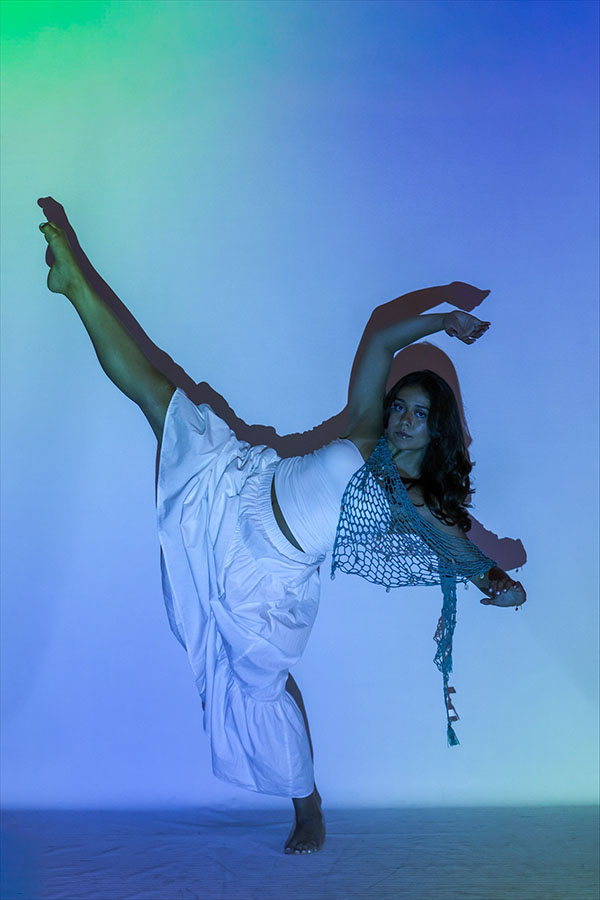
Dance played a significant role in Adela Camposano’s decision to pursue psychology.
“Growing up as a competitive dancer exposed me to incredible opportunities, but also to pressure, toxicity, and maturity at a very young age,” she explains. “This made me curious about mental health, which ultimately drew me to psychology.”
Adela is currently a CAS peer advisor and won the Social Science Poster Competition at the 2023 Robyn Rafferty Mathias Student Research Conference. She also worked in Health Studies Professor Elizabeth Cotter’s Health, Well-being, and Mindfulness Lab on a stress-reduction study with Latina mothers, where she helped evaluate how mindfulness practices can improve maternal health and overall family well-being.
Dance now plays a positive role in Adela’s life. “Since much of my STEM interest is tied to mental health,” she says, “I see dance as a form of emotional regulation and stress management, which connects closely to what I study and am interested in.”
Adela first started dance classes when she was three years old and transitioned into competitive dance by age six. “I competed at regionals and nationals every year and even toured with a dance convention in high school, which taught me a lot about discipline and how to balance a demanding schedule.” She notes that people in her STEM classes are often surprised to learn she is a dancer, while people in dance spaces sometimes forget she is also a STEM student. “When my worlds overlap, it reminds everyone, including myself, that I am just someone who works really hard in multiple areas and stays constantly busy balancing everything,” she says.
Ali Kirschbaum (BS biochemistry ’26)
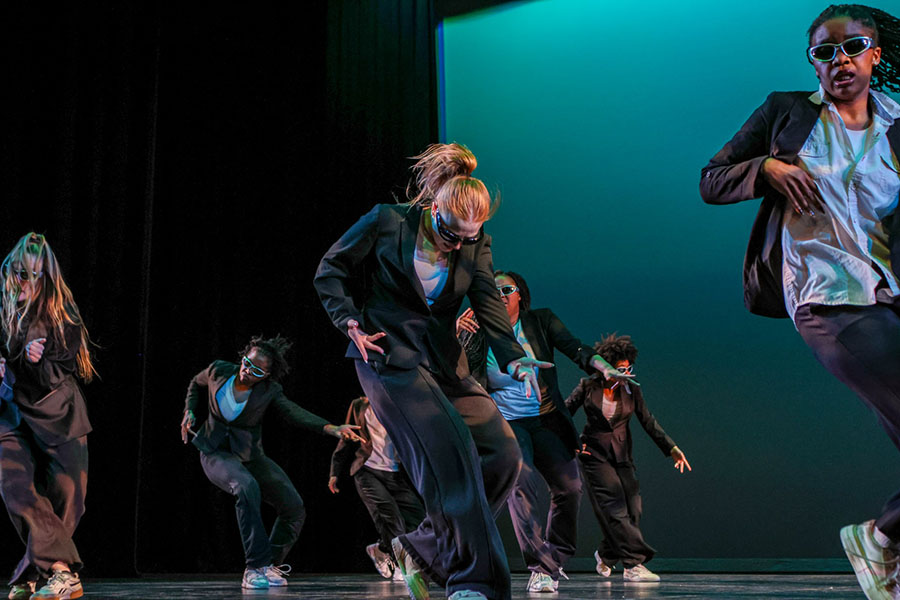
Ali Kirschbaum is at home at the intersection of disciplines, where science meets storytelling, and precision meets creative expression.
As a biochemistry student interning with the Smithsonian Institution’s Migratory Bird Center, Ali helped translate research into community outreach, sharing how bird populations are protected and how everyday citizens can help. In the summer, she conducted field research on how growing seasons affect automated radio telemetry systems used to track birds.
Ali’s academic path has evolved alongside these experiences. She initially chose her major for its connection to the natural world. “I chose biochemistry due to its relationship with plants and agriculture.” Over time, her focus sharpened. “At AU,” she says, “I have shifted my focus to an interest in genomics and bird conservation.”
Dance has been part of Ali’s life since she was four years old. Today, she dances with the American University Dance Company and Artists United in Motion, and works with a choreographer at Dance Place, a DC non-profit dance center.
Though the lab and the studio may seem worlds apart, Ali sees similarities. “Dance and STEM both require me to be detail oriented and focus on the task at hand,” she says. “Practicing dedication and taking ownership in my work has provided me the opportunity to succeed in both fields.”
Lia De la Rosa Adrian (BS biochemistry ’28)
Lia De la Rosa Adrian can’t remember when she first started dancing. “I just know I've been doing it for a very long time,” she says.
But after Lia’s family moved to the United States from the Dominican Republic, Lia stopped dancing. She focused instead on sports, playing squash during middle and high school, and it wasn't until she got to American University that dancing became an option again. “I finally mustered up the courage to audition for the African dance team Les Coeurs D'Afrique AU and got in,” she says. “After that, everything fell into place and I finally felt like I was doing something I wanted to do without pressure from anyone.”
During Lia’s freshman and sophomore years, she took part in the DIVAS Alliance Program, designed to teach students digital image analysis using Python. It opened the door for her to start working in a lab for the first time during the summer. “It was my first time doing research professionally, and I learned a lot about what it takes to plan and design a research project,” she says. “I chose to study biochemistry because I have always had an interest in learning how the world works through a scientific perspective and finding ways to help people live their best lives.”
Lia has learned that both research and dance take practice, and that you never start knowing exactly where things will go. “Both require being open to look for help to decipher a new choreography or research question. I think that's pretty cool,” she says. “I think people might be surprised at how much easier dance makes it for me to study and focus on class. Dance requires you to center yourself and focus on every movement you make. By applying those same skills to my classes and lab work, I found that I've done a lot better academically.”